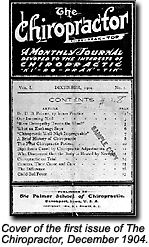
It's a human trait that we are not always consistent in what we say, and what we say and do don't always match. Words and actions may differ, which sometimes creates more problems than overt behavior. For example, it was D.D. Palmer's words, his published claims to cure "dis-ease" in The Chiropractor (magazine of the Palmer School), rather than his actual practice of chiropractic that resulted in his arrest, conviction and jailing in Scott County, Iowa in 1906. Similarly, in modern times, it is often the claims made for the chiropractic healing art (e.g., Grod, et al., 2001; Keating, 1988; Keating and Hansen, 1992), rather than the performance thereof, which creates problems for the profession. The simple wisdom of C.O. Watkins, DC, that we balance our boldness in devising novel methods of healing with caution in making claims to the public, often eludes the profession.
The disparity between chiropractic rhetoric and the actual beliefs and practices of the rank and file was driven home recently in an apparently random survey of 687 North American DCs (New, 2003). Bannered in the June 2, 2003 issue of Dynamic Chiropractic as "New Study Finds Unity in Chiropractic," the survey actually found consensus, rather than unity. There was considerable agreement about a number of clinical practices, although participants apparently diverged in how they identified themselves "philosophically"; the investigators allowed a three-category, self-classification scheme: "broad-scope" (mixer), "middle-scope," or "focused-scope" (straight). Although many American members of the profession continue to partition themselves politically (e.g., the American Chiropractic Association, the International Chiropractors Association, the National Association of Chiropractic Medicine, and the World Chiropractic Alliance), with the majority belonging to no national chiropractic organization (!), the survey reveals there are clear majority views and preferences.
Frankly, this is not news, as this most recent survey parallels, in some respects, studies conducted in 1928 (by the Research Bureau of the ACA) and in 1930 by the Lincoln Chiropractic College. Although the issues addressed in these earlier investigations do not always match up with those of the McDonald, et al., report, there is enough overlap to make the comparisons interesting. It is important to remember that once upon a time, straight chiropractic was the apparent majority view (certainly the "politically correct" stance) among doctors of chiropractic. "Subluxation" and its meaningfulness or appropriateness of terminology was not questioned.. Even so, times were changing, and chiropractors 75 years ago often seemed comfortable with a "greater than subluxation only" approach to the healing art. Additionally, the use of more than adjustive methods was the primary distinction between mixers and straights in that earlier era.
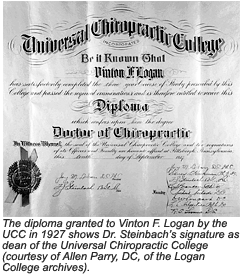
The ACA study (Survey, 1928) was conducted by Leo J. Steinbach, DC, dean of the Universal Chiropractic College (UCC) in Pittsburgh and director of the ACA's research bureau. (This earlier ACA was a precursor to the National Chiropractic Association, which, in turn, is the forerunner of today's ACA.) The survey methodology of 1928 would surely not pass muster today, but was a novelty in the profession at the time. No inferential statistics were employed; the appropriate statistical tests may not have been available in that earlier era. Steinbach noted that the survey questionnaire had been sent to 500 "representative chiropractors chosen from five separate lists." How the 500 were selected is not clear, and there was a disproportionate inclusion of UCC graduates in the final sample. (The overwhelming majority of chiropractors in 1928 were Palmer alumni, who are underrepresented in the final sample; see question #1 below.)
Steinbach informed readers of the Bulletin of the Research Bureau of the ACA that 302 DCs had returned the survey form, in various degrees of completion. Steinbach also stated that the letter accompanying the survey gave "the standard definition of chiropractic... a system of adjusting the segments of the spinal column by the human hands only for the cure of disease" (Survey, 1928). The UCC dean then indicated, "Those employing other methods, in addition to the above, to restore the sick to health, are listed as 'mixers.'"
The questions and answers received from this 1928 ACA investigation are reproduced here:
1. Of what chiropractic college are you a graduate?
U.C.C.
93 graduates
P.S.S.[sic: Palmer]
89 graduates
N.C.C. [National]
64 graduates
Carver
17 graduates
Pacific
7 graduates
Berkeley
5 graduates
N.Y.S.C.
4 graduates
Ross
3 graduates
Akron
3 graduates
Texas
3 graduates
Riley
2 graduates
Eastern
2 graduates
Miscellaneous
10 graduates
2. Do you practice straight chiropractic, exclusively?
65 answered in the affirmative; 237 answered in the negative.
3. If not, what supplementary methods do you use?
Amount
Method
81
diet, massage, and light therapy
59
general physiotherapy
22
diet only
23
diet, massage, and exercise
22
diet and exercise
12
diet and hydrotherapy
11
diet and spondylotherapy
7
radionics
4. Have you ever received instruction in other methods?
208 answered in the affirmative; 94 answered in the negative.
5. As a straight chiropractor, is your practice increasing, or not?
30 stated that it is increasing; 20 stated that it is decreasing; 15 stated that it is stationary.
6. Do you believe the employment of other drugless methods is an aid or detriment in the practice of chiropractic? Give reasons.
239 believe the use of other drugless methods to be a distinct aid for the following reasons:
Permits the chiropractor to cover a larger field than can be done with chiropractic alone.
Public demands something more than "a punch in the back."
Other methods aid very materially in removing contributing causes.
Reduces time element in getting patient well.
Enables chiropractor to give a more complete health service.
Relieves pain and congestion.
The use of other methods in conjunction with chiropractic creates increased public respect and confidence in chiropractic and the chiropractor.
The average patient wants one physician to care for all nonsurgical cases. The "straight" chiropractor cannot qualify in this respect.
60 believe the use of other methods to be a detriment for the following reasons:
Causes the practitioner to lose confidence in the principles of chiropractic.
Other methods cause expenditure of vitality necessary to the recuperative powers of the patient.
Creates confusion in the patient's mind as to just what chiropractic is.
To use other methods is to deny fundamental chiropractic.
Other methods get credit for results instead of chiropractic.
Did not answer this question.
7. Have you ever employed other methods and later discarded them and returned to straight practice? Give reasons.
14 replied in the affirmative, giving the following reasons for their action:
Because they wasted time and money and did no good.
Because the state law permits only "straight" chiropractic.
8. From your observation, would you say that "mixers" have a larger clientele than "straights?"
201 stated that "mixers" have the larger clientele.
14 stated that "straights" have the larger clientele.
80 stated that neither had any advantage.
7 were noncommittal on this question.
9. From your observation, is chiropractic gaining or losing public confidence?
224 stated that chiropractic is gaining.
69 stated that chiropractic is losing.
9 failed to answer this question.
10. What is the general opinion of chiropractic in your community?
180 stated that it is good; 88 stated that it is fair; 34 stated that it is poor.
11. Do you think that chiropractic colleges should instruct their students in other drugless methods?
243 answered in the affirmative; 59 answered in the negative.
12. Do you believe the successful chiropractors of the future must also include other drugless methods?
238 answered in the affirmative; 64 answered in the negative.
13. Did you begin practice as a "straight" and then later include other methods or adjuncts? Give reasons.
154 answered in the affirmative and cited the following reasons:
Realized that "straight" chiropractic was too limited in its application.
Adopted other methods through observing better results secured by those who used them.
To broaden the field of practice.
In order to give relief in cases that would otherwise have consulted physicians.
Because of economic pressure. Patients were deserting to the "mixer."
14. In your opinion, what is the greatest need in chiropractic today?
97 percent of those replying consider all or part of the following to be the greatest needs confronting the profession today:
Strict adherence on the part of the schools to the rule requiring high school diplomas as a minimum preliminary educational requirement. Greater discrimination in accepting students.
Minimum course of 24 of months professional training.
A universal system of adjusting.
A comprehensive national advertising or educational campaign.
One national organization, with each state society as an affiliated unit of that organization.
Greater tolerance between "straights" and "mixers." A union of forces against the common enemy.
Higher ethical standards.
Incorporation into the curriculum of chiropractic colleges of other drugless methods of proved value.
Elimination of inferior schools.
A reasonable chiropractic law in each state.
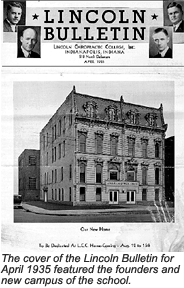
Reprinted in one of the early histories of the profession (Turner, 1931), the Lincoln College's apparently nonrandom sample of more than 1,800 DCs found consensus among practitioners in matters of diagnosis, and divergence in matters of nonadjustive therapeutics. The Lincoln, established at Indianapolis in 1926 to provide an alternative to the Palmer School (Keating, 1990, 1998), did not teach physiotherapies, and so was considered a "straight" chiropractic school, with an above-average commitment to rigor in teaching the basic and diagnostic sciences. (Unfortunately, the original report of the Lincoln survey is not available to this author, and its republication in Chittenden Turner's The Rise of Chiropractic does not indicate how the sample was chosen.)
However, if Lincoln alumni predominated in the sample, then the survey results (see table below) might be construed to reflect "straight" chiropractic college graduates of some seven decades ago. Of particular interest is the contrast among some questions that asked respondents how they practiced vs. what they thought was appropriate instructional content for chiropractic schools.
The following are the results of a survey conducted
Survey Questions
% Yes*
Yes
No
Total*
1. Is your examination confined to the spine?
18%
345
1,538
1,883
2. Do you question your patients about subjective symptoms (abnormal symptoms)?
95%
1,773
88
1,861
3. Do you investigate objective symptoms (through inspection, palpation, percussion, auscultation, etc., other than the spine)?
86%
1,608
261
1,869
4. Do you examine the heart and pulse?
86%
1,581
257
1,838
5. Do you employ a spinal meter instrument (either resistance type or thermo-couple type)?
35%
657
1,205
1,862
6. Do you use any of the various types of "radionics equipment?
16%
299
1,560
1,859
7. Do you take the blood pressure?
77%
1,449
422
1,871
8. Do you use the clinical thermometer?
78%
1,462
411
1,873
9. Do you employ urinalysis?
78%
1,465
419
1,884
10. Do you advise your patients as to diet?
89%
1,656
211
1,867
11. Do you advise as to exercise, habits, etc.?
88%
1,647
220
1,867
12. Do you employ massage?
55%
1,004
817
1,821
13. Do you use a vibrator?
28%
541
1,352
1,893
14. Do you employ a heat lamp?
48%
895
966
1,861
15. Do you employ radionics?
16%
302
1,562
1,864
16. Do you use "light therapy?
37%
685
1,173
1,858
17. Do you employ any form of "electro-therapy?
32%
603
1,257
1,860
18. Do you employ any form of "hydro-therapy (baths, enemas, colonic irrigation, etc.)?
40%
743
1,124
1,876
19. Do you practice "foot correction?
49%
902
954
1,856
20. Do you give spinal adjustments to every case?
82%
1,563
330
1,893
21. Do you favor chiropractic schools teaching diagnostic methods
90%
1,704
179
1,883
22. Do you favor chiropractic schools teaching "light therapy?
54%
975
831
1,806
23. Do you favor chiropractic schools teaching "hydro-therapy?
56%
991
788
1779
24. Do you favor chiropractic schools teaching "electro-therapy?
48%
855
931
1,786
25. Do you favor chiropractic schools teaching "radionics?
30%
491
1,151
1,642
26. Do you favor chiropractic schools teaching massage?
63%
1,144
661
1,805
27. Do you favor chiropractic schools teaching "foot correction?
74%
1,323
477
1,800
28. Do you favor chiropractic schools teaching diet?
90%
1,667
194
1,861
by the Lincoln Chiropractic College in 1930 (Turner, 1931, pp. 208-11). *This column not included in original survey
There have been a number of surveys of opinion and practice among chiropractors during the past 70 years, some conducted from within the profession (e.g., Chiropractic, 1962), and some by outside observers (e.g., Stanford, 1960). Recognition of the commonalities among DCs has an equally long history, as suggested by the plea of Carl S. Cleveland, Sr., D.C. and others in the 1930s: "Unity in essentials - liberty in nonessentials" (Cleveland, 1933). Then, as now, however, chiropractors do not always agree on "the fundamentals," and when they do (e.g., the meaningfulness of subluxation), a willingness to make claims beyond what the scientific literature justifies, claims that grate on the ears of the scientific community, seems to sustain the profession's historic ostracism. This willingness bespeaks the diversity of epistemologies in the profession (Keating, 1989; 1993), an issue of philosophy that has rarely been addressed by the profession.
So, what may be gleaned from this cursory consideration of surveys then and now? Beliefs and practices do change in chiropractic, albeit sometimes rather slowly. There has probably always been consensus (clear majority opinion) on some issues of concern (e.g., diagnosis, the validity of subluxation), although some bases for agreement have changed over the years (e.g., appropriateness of physiotherapeutics). Simplistic, dichotomous (or even trichotomous) labels such as "straight" and "mixer," although long part of the jargon in the profession, misrepresent the complexity and diversity (Keating, 1992) of opinions that DCs hold.
And as ever, a good deal more research is warranted.
References
Chiropractic survey and statistical study: report to the Board of Directors of the National Chiropractic Association. Des Moines IA: Batten & Associates, Inc., 1962.
Cleveland, Carl S. Unity in essentials - liberty in nonessentials, pleads this leader! The Chiropractic Journal (NCA) 1933 (July);1(7):9.
Grod J, Sikorski D, Keating JC. The unsubstantiated claims of the largest state, provincial and national chiropractic associations and research agencies. Journal of Manipulative & Physiological Therapeutics 2001 (Oct);24(8):514-9.
Keating JC. Editorial: Making claims. Journal of Manipulative & Physiological Therapeutics 1988 (Apr);11(2):75-7.
Keating JC. A survey of philosophical barriers to technique research in chiropractic. Journal of the Canadian Chiropractic Association 1989 (Dec);33(4):184-6.
Keating JC. Letter to the editor re: The last days of BJ Palmer (Lincoln walkout: was it prompted by the NCM?). Chiropractic History 1990 (June);10(1):8; reprinted in the Lincoln Bulletin 1991 (Mar);4(1): 1-2.
Keating JC. Shades of straight: diversity among the purists. Journal of Manipulative & Physiological Therapeutics 1992 (Mar/Apr);15(3):203-9.
Keating JC. Scientific epistemology and the status of chiropractic: we are what we do. European Journal of Chiropractic 1993 (Dec);41(3):81-8.
Keating JC. Lincoln College: a glimpse at the early years. Dynamic Chiropractic, 26 January 1998, pp. 29, 32-3, 40-2.
Keating JC. Hansen DT. Quackery vs. accountability in the marketing of chiropractic. Journal of Manipulative & Physiological Therapeutics 1992 (Sept);15 (7):459-70.
New study finds unity in chiropractic: surprising agreement among DCs on issues of philosophy, practice. Dynamic Chiropractic 2003 (June 2);21(12):1, 8, 10.
Stanford Research Institute. Chiropractic in California. Los Angeles: Haynes Foundation, 1960.
Survey of chiropractic methods of practice. Bulletin of the Research Bureau, American Chiropractic Association 1928 (June);5(6):1-4.
Turner, Chittenden. The Rise of Chiropractic. Los Angeles: Powell Publishing Company, 1931.
Note: The Association for the History of Chiropractic (AHC) will hold its April 2004 Conference on Chiropractic History will be held in Mexico City in March. Details about the upcoming conference can be obtained by checking the AHC website at www.chirohistory.org.
The proposed merger of the National Board of Chiropractic Examiners and Federation of Chiropractic Licensing Boards was approved by NBCE delegates and FCLB members at their respective annual meetings, held jointly in Atlanta, Ga., this year. Per the new bylaws, the new entity takes the NBCE name, with FCLB continuing as a department within NBCE. The federation will continue to enjoy Board of Directors representation on what will be a single, expanded board.
Before introducing subscapularis syndrome as an upper extremity analog, it is essential to revisit piriformis syndrome as a well-established example of myogenic pseudo-radiculopathy. Piriformis syndrome has long served as a clinical exception to disc-centric models of lower extremity pain and provides an important framework for understanding how deep muscular dysfunction can mimic radiculopathy in the absence of nerve root compression.
Pain has become the dominant language of musculoskeletal healthcare. Numeric pain-rating scales and symptom reports are routinely used as primary indicators of clinical success. But while pain reduction is meaningful, it is an incomplete and often misleading representation of recovery. This has real consequences for patient adherence, long-term outcomes, and how conservative care is perceived within the broader healthcare system.