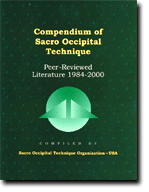
Compendium of Sacro Occipital Technique: Peer-Reviewed Literature 1984-2000
Book Review by Steven Lavitan, DC, LAc
Title:
Compendium of Sacro Occipital Technique: Peer-Reviewed Literature 1984-2000
Author:
Sacro Occipital Technique Organization - USA
Publisher:
Eastland Press
Length:
341 pages, softcover
Category:
Practitioner education
Price:
$55
Part #:
T-227
A review of chiropractic history helps put this book in proper perspective. Dr. Major Bertrand DeJarnette ("the Major"), the progenitor of sacro-occipital technique (SOT), was one of the first (and quite possibly the most influential) of the low-force researchers. When I went to chiropractic school in the 1970s, the three major techniques were Gonstead, applied kinesiology and SOT.
Dr. Gonstead's brother may have studied with the Major, and the old-time SOTers felt the X-ray marking system Gonstead used was related to a system Dr. DeJarnette developed. George Goodhart's father studied with the Major, and George spent time with him as a boy. After the Palmers, many chiropractors believe DeJarnette's influence was the most powerful.
There was a variety of information circulating about Dr. DeJarnette, including that he was an osteopath first and had been helped by Dr. William Garner Sutherland, the father of osteopathic craniopathy. One thing we know for sure is that Dr. Sutherland influenced him and his approach, particular regarding cerebrospinal fluid (CSF) flow and torque of the dura. The Major also wrote extensively about blocking technique; cranial work; pain control; bloodless surgery, which evolved into chiropractic manipulative reflex technique; extremity technique; color therapy or chromotherapy; and even nutrition.
Dr. DeJarnette self-published his research from the 1920s through the 1980s. When he passed away in the early 1990s, the Sacro Occipital Research Society International (SORSI), a collection of chiropractors with a passionate interest in the technique, helped keep SOT alive. The Sacro Occipital Technique Organization - U.S., broke from that organization for political reasons; many of the greater lights in the technique are affiliated with this organization, which published this book.
Compendium of Sacro Occipital Technique is a provocative anthology. There is a feeling in the chiropractic profession that research is necessary, and that any clinician can contribute. On a certain level, this is true, but there is no earth-shattering new discovery here. There are some interesting case reports; correlations between SOT and other forms of analysis; anatomy and physiology of the technique; and quite a bit about cranial work. All and all, it is worthwhile reading for a practitioner with an interest in SOT.
This book reminds me of the Yearbooks of Osteopathy, but with less original basic science research. Marc Pick's article is among the notable exceptions. The only reason I give the Compendium a nine instead of a 10 is that there was no continuity between the chapters, which is inadequate for someone desiring a comprehensive overview of SOT. However, for someone starting with advanced knowledge of SOT, this book will certainly prove valuable.
Dr. DeJarnette did a considerable amount of good. He synthesized a manual therapy that was the most sophisticated, comprehensive technique of the time. He pioneered and popularized the use of blocks, which in many ways are an extra pair of hands that let the sacrum float back into its proper position. My guess is that millions of people have been helped by this method over the years.
Dr. Lavitan's rating:
9out of
If you have authored, published or produced a book, audio or video package that is chiropractic-oriented, educational, nonpromotional and written or produced in a professional manner, and would like it reviewed in Dynamic Chiropractic, please send two copies of the book, video or audiocassette to:
Review Editor Dynamic Chiropractic P.O. Box 4109 Huntington Beach, California 92605-4109
The proposed merger of the National Board of Chiropractic Examiners and Federation of Chiropractic Licensing Boards was approved by NBCE delegates and FCLB members at their respective annual meetings, held jointly in Atlanta, Ga., this year. Per the new bylaws, the new entity takes the NBCE name, with FCLB continuing as a department within NBCE. The federation will continue to enjoy Board of Directors representation on what will be a single, expanded board.
Before introducing subscapularis syndrome as an upper extremity analog, it is essential to revisit piriformis syndrome as a well-established example of myogenic pseudo-radiculopathy. Piriformis syndrome has long served as a clinical exception to disc-centric models of lower extremity pain and provides an important framework for understanding how deep muscular dysfunction can mimic radiculopathy in the absence of nerve root compression.
Pain has become the dominant language of musculoskeletal healthcare. Numeric pain-rating scales and symptom reports are routinely used as primary indicators of clinical success. But while pain reduction is meaningful, it is an incomplete and often misleading representation of recovery. This has real consequences for patient adherence, long-term outcomes, and how conservative care is perceived within the broader healthcare system.