Breathe Well and Breathe Often (Part 4): Half-Kneeling, Stabilizing, Moving and Breathing
Robert "Skip" George, DC, CCSP, CSCS
It is safe to say that every practicing doctor of chiropractic has treated patients with back pain. Almost every patient with back pain will have some kind of spinal alignment or movement dysfunction that either caused the problem or is now a consequence, even when the pain disappears.2-3 As mentioned in the previous three articles in this series on breathing, the most common movement dysfunction is breathing.
From the time we develop as infants, grow into adulthood and then head into our senior years (for many of us once again kicking and screaming like infants), the challenges remain the same from a dynamic and structural standpoint: How do we move, stabilize and breathe in a pain-free, coordinated and functional manner?
Providing even a simple corrective exercise strategy to our patients presents with more complexity in today's practice than most of us care to admit. Handing the patient printed instructions to read and perform on their own is about as effective as handing the printed sheet into the round file in the corner of your office. Efficient and simple verbal instruction progressing one exercise to the next is key in moving a patient from passive care to becoming a more active partner who does their part in maintaining not only spinal health, but also overall well-being.
One of the challenges is selecting an exercise that matches a patient's specific needs. Addressing alignment, movement or stabilization dysfunctions while educating the critical nuances of basic form provides the patient with an awareness of what got them in trouble in the first place and how to self-correct and retrain basic neuromusculoskeletal patterns. The biggest challenge is consistent follow-through with daily practice by the patient all on their own.
You may notice that even with detailed instructions for a simple exercise, the next time the patient comes into your office that same exercise may not resemble what you showed them just a few days before. Just ask them to teach you what you taught them for revealing insight of what most patients actually take in. Repetition and patience is needed for every exercise (and that includes whenever we learn something new).
Half-Kneeling as a Progression to Teach Functional Breathing
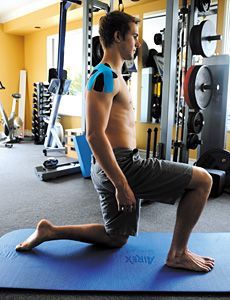
One deceptively simple-looking position that could be classified as a corrective exercise or basic functional position is half-kneeling.It is really part of a progression that incorporates functional breathing; first starting supine, then prone, then tall-kneeling and then into half-kneeling, advancing to sitting and finally standing. For many patients with mobility dysfunctions (like being very stiff and tight in the hip flexors; immobility of the thoracic spine) or with balance problems, the basic set-up of half-kneeling can be daunting.1-2
For instance, when just getting into the set-up position, many patients wobble or need to hold a dowel pushed into the ground for support so they don't fall over. This is especially true for the older patient, who often has balance, movement and flexibility issues. The relationship between balance and movement can be dramatically revealed in this simple position.
Adjustments and manual therapy may be needed to help the patient reset their ability to get into position.3 With many patients, this is also a good time for you to talk about hydration, ergonomic issues and perhaps even provide corrective taping to reinforce a particular pattern.3
Adding to the challenge of this position is that narrowing the stance with the knee on the ground, hips and torso directly above and the front leg aligned with the heal and back knee perfectly in one line for a narrow base of support, tests the patient on how well they balance with a minimum of muscular effort.1-2 The real trick is to see if the patient can do all that and breathe functionally (as described in previous articles on breathing in this series) without recruiting accessory muscles like the scalenes, trapezius or SCMs.
Watch what happens for many patients who simply try to get into position and then add breathing while in half-kneeling. In an attempt to stay in position and balanced, they may wobble and lose balance. While attempting to stay balanced and breathe, the patient may recruit the above-mentioned accessory muscles and find themselves struggling to breathe and stabilize.
Adding a movement exercise like chops or lifts can reveal just how difficult it is to stabilize, breathe and move in a functional and coordinated fashion. (Please refer to the excellent article by Dr. Perry Nickleston, April 9, 2012 issue of DC, regarding half-kneeling with chops and lifts.) In a matter of no time, a simple-looking exercise can reveal breathing, movement and stabilization issues in all planes of movement.
Any time there is too much difficulty versus a workable challenge, the difficulty of the exercise needs to be made more simple or "peeled back." For example, the "peel-back" from half-kneeling may be to have wider placement of the front foot or move back to tall-kneeling.1-3 At each stage of the exercise progression, if the patient is unable to maintain balance, stability, breathe and move well, then reduce the difficulty before moving forward in the progression.
Once the position is mastered, then loading with resistance training like chops and lifts reloads that movement pattern.3 However, the setup is everything and often can take 2-4 units of billable rehabilitation time.2-3
Instructions for Half-Kneeling1
Knee straight under hip; center the weight on the down knee, supported with the up leg, but keep the knee straight under hip. Don't shift to the front, side or tilt.
Lower leg of the down knee should point straight back.
To point or not to point the toes on the down leg? You can experiment with this one; pointing the toes usually results in more subtle core activation versus stabilizing with a dorsiflexed foot and toes.
Pelvis position: The bowl of the pelvis should be neutral or slightly tilted back. Often patients will recruit the glutes to achieve a neutral pelvis. Using gentle, but just enough firm anterior abdominal musculature activation to maintain pelvic position while breathing is a more functional way to maintain position without initiating a high threshold strategy using glutes or excess abdominal wall activation.1,3
Maintain a tall spine; lengthen up like a string is lifting you from the center of your head.
Still grounded: Remember your connection to the ground. Your down leg is really a kickstand of sorts, with the pelvis and shoulders balanced directly over the knee. Use a yoga-type mat if the patient's knee is sensitive to ground contact.
Square off; your shoulder and pelvis should continue to be squared off.
At all times, keep your neck and face relaxed and remember to breathe.
As you can tell, even seemingly simple exercises have subtle, critical nuances, and every nuance matters. The ability to move, stabilize and breathe in a coordinated manner often dictates injury predictability and athletic performance. Thus, whether your patient is a weekend warrior, professional athlete or a senior who just wants to take long walks with their grandchildren, the half-kneeling stance, integrated in a progression from easier positions, can be an invaluable tool in maintaining spinal and functional corrections. In addition, it is really fun to experience not only the satisfaction of getting patients better with your chiropractic care, but also seeing them move, stabilize and breathe well in an artful and carefully crafted corrective exercise program. Details, precision and excellence matter – and by the way, they are also some of your best referral tools!
References
Cook G, Jones B. Functional Movement Screen Advanced Corrective Exercise Manual; page 50.
Cook G. Movement: Functional Movement Systems. On-Target Publications, 2010.
Plisky P, Kiesel K. The Selective Functional Movement Assessment (SFMA) Training Manual.
Part 1 of this article appeared in the June 17, 2012 issue; part 2 ran in the July 15 issue; and part 3 appeared in the Sept. 9 issue.
The proposed merger of the National Board of Chiropractic Examiners and Federation of Chiropractic Licensing Boards was approved by NBCE delegates and FCLB members at their respective annual meetings, held jointly in Atlanta, Ga., this year. Per the new bylaws, the new entity takes the NBCE name, with FCLB continuing as a department within NBCE. The federation will continue to enjoy Board of Directors representation on what will be a single, expanded board.
Before introducing subscapularis syndrome as an upper extremity analog, it is essential to revisit piriformis syndrome as a well-established example of myogenic pseudo-radiculopathy. Piriformis syndrome has long served as a clinical exception to disc-centric models of lower extremity pain and provides an important framework for understanding how deep muscular dysfunction can mimic radiculopathy in the absence of nerve root compression.
Pain has become the dominant language of musculoskeletal healthcare. Numeric pain-rating scales and symptom reports are routinely used as primary indicators of clinical success. But while pain reduction is meaningful, it is an incomplete and often misleading representation of recovery. This has real consequences for patient adherence, long-term outcomes, and how conservative care is perceived within the broader healthcare system.