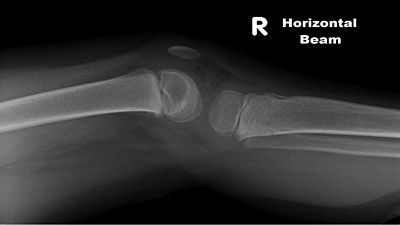
A trampoline fracture is a transverse fracture of the proximal tibial metaphysis occurring in children while jumping on a trampoline (or inflatable castle). This fracture was first described by Richard Boyer, et al., in 1986.1 The fracture occurs when a second, usually heavier individual causes the jumping surface to recoil upward as the unsuspecting victim is descending. The combined excessive load is thought to produce the characteristic fracture, which is most often seen in children 2 to 5 years of age. This fracture has also been observed when a child is jumping on a bunk-bed mattress and another child pushes up on the mattress from the bunk below.
Both scenarios are not uncommon when children are playing; even when adults are present there seems to be a lack of knowledge about this type of injury. I myself have been at birthday parties where this very scenario was happening, especially on the popular blow-up play gyms people often rent for the day. Fortunately, this injury is not particularly common; nonetheless, allowing kids of all ages and weights to jump together is not a good practice. It can really ruin a birthday party.
Mechanism of Injury
A review of the literature concurs that most injuries happen on the trampoline mat when there are multiple users present. This particular tibial fracture occurs through a phenomenon called "kipping," whereby synchronous jumping by multiple users – jumping at the same time – causes the transfer of kinetic energy to the lightest person, causing them to gain greater propulsive force and height. (Remember the tumbling trick to get the lightest person on top of the human pyramid?)
The mechanism of injury can be explained simply that when two masses bounce out of phase on a trampoline, a transfer of kinetic energy from the larger mass to the smaller mass is likely to occur. It is estimated that when an 80 kg (176 pound) adult is on a trampoline with a 25 kg (55 pound) child, the energy transfer is equivalent to the child falling 2.8 meters (more than 9 feet) onto a solid surface. Additionally, the rate of loading on the child's bones and ligaments is greater than that on the accompanying adult. This phenomenon does not occur with asynchronous jumping, which causes less-skilled jumpers to be propelled at unplanned angles, resulting in collisions and misplaced landings.
Other Considerations
Trampoline jumping poses a high risk of injury for both children and adults. Falling off a trampoline or using a trampoline incorrectly can result in strains, sprains, fractures and other injuries, including potentially serious head and neck injuries. In fact, the risk of injury is so high that the American Academy of Pediatrics (AAP) says trampolines should never be used at home or in outdoor playgrounds.
The AAP supports limited use of trampolines in supervised training programs, such as gymnastics and diving classes Even then, strict safety guidelines must be followed. For some reason, this advice is not being heeded.2-3 Last year alone, an estimated 98,000 people were treated in emergency rooms for trampoline-related injuries; 82 percent were children under the age of 15. The trampoline industry says sales of backyard trampolines have soared, with more than 1 million now sold every year.
Marc Rabinoff, a trampoline safety expert and professor in the Department of Human Performance and Sport at Metropolitan State College in Denver, has labeled trampolines "quad machines," because they can make you a quadriplegic in four seconds.4 Indeed, jumping on a trampoline can cause serious spinal injuries, in particular injury of the cervical spine. (In case you can't imagine this, take a look at this not-so-funny YouTube video: http://youtu.be/08VIWieD82Y.)
Patient is a 5-year-old with a transverse fracture of the proximal tibial metaphysis ("trampoline fracture"). The injury occurred while jumping on a trampoline with his father.
Warnings on trampolines say no flips, no jumpers younger than 6 years of age, and only one jumper at a time, but those warnings are often ignored. People don't realize trampolines are a danger in their backyard. Remember, jumping with more than one person on the trampoline is when most of the more serious injuries occur.
The industry states that 50 percent of injuries can be avoided with netting, but they still sell trampolines without nets.4 Moreover, a net does not protect participants from the recoil injuries that occur with users of different weights. Current guidelines are clear that more than one user on a trampoline at a time is a risk factor for serious injury; however, the majority of injuries still happen in this scenario. There is no substitute for common sense.
References
Boyer RS, Jaffe RB, Nixon GW, Condon VR. Trampoline fracture of the proximal tibia in children. AJR Am J Roentgenol, 1986;14683-85.
M. Nysted, JO Drogset. Trampoline injuries. Br J Sports Med, 2006;40:984-987.
McDermott C, Quinlan JF, Kelly IP. Trampoline injuries in children. J Bone Joint Surg (U.K.), June 2006;88-B(6):796-798.
Santomauro R. "Facts You May Not Know, But Should! Hidden Dangers of Trampolines." Nash & Associates, LLC, medical malpractice blog; posted April 30, 2010.
The proposed merger of the National Board of Chiropractic Examiners and Federation of Chiropractic Licensing Boards was approved by NBCE delegates and FCLB members at their respective annual meetings, held jointly in Atlanta, Ga., this year. Per the new bylaws, the new entity takes the NBCE name, with FCLB continuing as a department within NBCE. The federation will continue to enjoy Board of Directors representation on what will be a single, expanded board.
Before introducing subscapularis syndrome as an upper extremity analog, it is essential to revisit piriformis syndrome as a well-established example of myogenic pseudo-radiculopathy. Piriformis syndrome has long served as a clinical exception to disc-centric models of lower extremity pain and provides an important framework for understanding how deep muscular dysfunction can mimic radiculopathy in the absence of nerve root compression.
Pain has become the dominant language of musculoskeletal healthcare. Numeric pain-rating scales and symptom reports are routinely used as primary indicators of clinical success. But while pain reduction is meaningful, it is an incomplete and often misleading representation of recovery. This has real consequences for patient adherence, long-term outcomes, and how conservative care is perceived within the broader healthcare system.