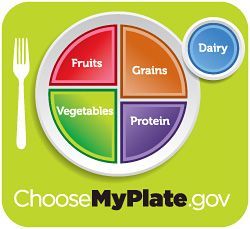
The much-maligned USDA (United States Department of Agriculture) food pyramid has been replaced by a four-quadrant plate. The pyramid had little impact on the average person for the simple reason that people do not think of meals in the form of a pyramid. People also do not think in serving sizes. For example, ask each person at the local submarine sandwich shop if they know the $5 foot-long they just ate had four servings of bread. Better yet, ask health professionals; you'll discover a surprising percentage of the people who should know don't know, either. You could even ask a bonus question like what a serving of grated carrots looks like. But be warned, you'll discover the easy sounding serving of grated carrots question is harder for doctors and therapists to get right than asking them to name an autoimmune disease that attacks joints.
In 2005 a redesigned pyramid with vertical bands replaced the pyramid that contained rows of boxes. It continued to provide little value for the average person. I thought it was a step backward from the 1992 version it replaced. I think the plate is a huge improvement over the pyramid. But not everyone agrees.
I was moved to write this article after surfing the Web and encountering a good deal of criticism from the alternative health care community when the USDA plate (MyPlate) was unveiled. From a clinician's point of view, I do not think they could have been more wrong. The plate is a way to feed the public information in an easily digestible manner (puns intended). Unlike the pyramid, the plate has a chance to be comprehended by average folks because average folks put their food on plates. In other words, the plate is how people think.
Better still, health care professionals can easily customize it for individual patients or even design plates for specific meals. I know it's no secret that the USDA is neither cutting edge nor immune from food industry influence, and it is no secret that the optimal diet is still being debated. This has led to some of the MyPlate criticisms. (Table 1)
Criticisms of MyPlate as Circulated on the Internet
Too much protein
Not enough protein
Too many carbohydrates
Not enough fat
Protein is on the plate
Too much fruit
Too many grains
Too much low-fat dairy
When I heard they were going to replace the second pyramid, I was hoping for improvement. Unlike others, my expectation bar was not very high; so from my low point of view, MyPlate is a clear improvement. Of the list of criticisms, the biggest complaint was that the plate had a protein section. This was because the other three sections on the plate – vegetables, fruits and grains – are food groups, while protein is a nutrient class.
I agree this may be confusing to some, but I do not think it will cause a fraction of the confusion the food pyramid did. Furthermore, had they called it "meats," "legumes and nuts" or "meats, nuts and legumes," the complaints would have still rolled in. Even if protein is misunderstood, filling half of the plate with fruits and vegetables won't be. (I was disappointed that "grains" wasn't labeled as "whole grains.")
As for the other criticisms, arguments about what is best to eat started as soon as man began to study nutrition. In fact, it ranks just behind religion and politics in its ability to create a heated discussion. Since I have been interested in nutrition, there have been major paradigm shifts, beginning with a researcher named Nathan Pritikin, who improved his own health problems with a very low-fat, low-protein, very high (unrefined) carbohydrate diet.
Initially scorned, it was eventually embraced by both allopathic and alternative providers. It also inspired a number of other diets which were variations of his basic idea. Unfortunately, the interpretation of the diet became diluted by the time it reached the general public. Somehow "unrefined carbohydrate" became "any carbohydrate."
And when high-carb advocates said you can't get fat eating carbs, the public didn't gorge on the same carbs – greens, beans and colored veggies – as the experts did. Their carbs of choice were huge quantities of breads, bagels and pasta. To make matters even worse, the public put fats like cheese on those carbs before they ate them. The results were record-setting weight gains across the population.
Isaac Newton's Third Law states that "for every action comes and equal and opposite reaction." And in the case of the high-carbohydrate diet, it appeared in the form of Dr. Robert Atkins, a man who attacked carbohydrates with the same ferocity that Pritikin used on fats. He advocated a very low-carbohydrate, high-protein, high-fat diet. Like Pritikin, Dr. Atkins' concept was immediately slammed and he was ridiculed. Partial acceptance took many years and like Pritikin, most of the Atkins acceptance was for variations of the original plan. In the latter case, this meant more fiber and limited saturated fats in the context of a high-protein, high-fat, low-carb meal plan.
Today, we have a confused public and a philosophical divide between health and nutrition providers across numerous disciplines whenever the topic of "healthiest diet" comes up. So it's really no surprise MyPlate did not satisfy all parties. But those of you who were initially unhappy should take a second look from the point of view of a confused patient and remember that if half of the plate is fruits and vegetables, that's a big step in the right direction. Next month, we will begin a series on what foods the healthiest people around the world actually eat.
For chiropractors practicing today, Dr. Warren Hammer’s legacy is particularly visible in several areas that have become familiar components of modern musculoskeletal care: his early work with the Graston Technique and instrument-assisted soft-tissue mobilization; his extensive writing and teaching on functional soft-tissue examination and treatment; his role in bringing fascial manipulation to U.S. clinicians; and his decades spent educating chiropractors and other health professionals.
Financial pressure, enrollment declines and institutional challenges are emerging at several U.S. chiropractic colleges. Life Chiropractic College West's and Life University's struggles may be the most talked about but appear to be part of a larger story. And with recent USDE requirements threatening to hamstring federal student financing for DC degree programs, chiropractic education is facing questions for which it has no immediate answers.
As the world remembers Dolly Parton following her death Aug. 25 at age 80, there is a little-known connection to the chiropractic profession worth revisiting: Dolly publicly acknowledged using chiropractic care and another famous entertainer even recalled meeting her at a chiropractor's office.