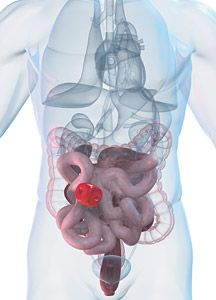
Crohn's disease is an inflammatory condition that usually affects the final part of the small intestine (the ileum) and the first section of the large intestine. It often causes bloody stools and malabsorption problems. The most common symptoms include chronic diarrhea with abdominal pain, fever, loss of appetite, weight loss, and a sense of fullness in the abdomen. About one-third of people with Crohn's have a history of anal fissures (linear ulcers on the margin of the anus) or fistulas (abnormal tube-like passages from the rectum to the surface of the anus).
The cause of Crohn's disease is not fully known. Management of this condition requires involvement of a trained dietician and a medical doctor, as acute flare-ups of Crohn's disease (periods of exacerbation) can have life-threatening consequences, and may require that the patient be hospitalized. Registered dieticians, working in concert with the patient's physician, play an important role in the dietary management during flare-ups of the condition. They have extensive training in the nutritional management of these cases, and may be able to identify individual food sensitivities that are unique to that patient.
Unfortunately, the conventional management of Crohn's disease by the medical profession and registered dieticians usually does not emphasize the use of nutritional supplements, some of which have been reported to prevent or reduce the number of flare-ups of the disease, improve the health of the intestinal cells, improve nutrient absorption, and produce other desirable health effects. As such, holistic health practitioners should consider offering Crohn's disease patients advice about nutritional supplementation (and dietary practices) for the patient to consider during periods of remission, as a means to prevent recurrence or frequency of flare-ups, and to support the patient's constitution in general.
Supplementation Suggestions
High-Potency Multivitamin/Mineral. Studies demonstrate that many individuals with Crohn's disease experience decreased absorption of zinc, folic acid (a B vitamin), vitamin B12, vitamin D, vitamin E and iron, and often demonstrate suboptimal nutritional status of these nutrients. In some of these patients, the folic acid deficiency is responsible for the development of pain, numbness and tingling in the fingers and toes.
Zinc deficiency is commonly found in Crohn's disease. Some sufferers develop skin conditions such as eczema and psoriasis. Studies suggest that providing supplemental zinc can improve both skin and vision problems in Crohn's disease patients in many instances. In some studies, patients with Crohn's disease have been found to have significantly lower levels of vitamin E compared to normal subjects. Zinc, folic acid and vitamin B12 are all needed to repair intestinal cells damaged by Crohn's disease. Vitamin A is needed for the growth and repair of cells that line both the small and large intestine. Thus, a high-potency multivitamin/mineral should be considered in the nutritional support of such cases, one that includes the following:
B-50 complex - 50 mg of most of the B vitamins, along with 400 mcg of folic acid
Vitamin E - 400 IU (vitamin E succinate)
Vitamin D - 400 IU (the patient should also take an additional 1,000-2,000 IU of vitamin D separately)
Iron - 6 mg
Zinc - 15 mg
Vitamin A - 2,500 IU
Vitamin C - 1,000 mg
Essential Fatty Acids (borage seed, flaxseed and fish oil; 1,200-3,600 mg per day). Some studies report that patients with Crohn's disease are low in omega-3 fatty acids. In clinical studies, supplementing with omega-3 fats decreased the recurrence rate of Crohn's disease in some trials. Essential fatty acids are converted into hormones that suppress the inflammatory process. This is how the combination of borage seed, flaxseed and fish oil is thought to help suppress the inflammatory process associated with a number of conditions.
Natural Anti-Inflammatory Agents. The combination of white willow bark extract, curcumin, ginger and boswellia has been shown to block the synthesis of inflammatory prostaglandins and leukotrienes that play a key role in all inflammatory conditions. Additionally, curcumin and the active ingredients in ginger (gingerols) have been shown to block the secretion of nuclear factor kappa beta, a premier transcription factor that promotes the release of inflammatory cytokines in most autoimmune diseases.
Curcumin has also been shown to suppress the oversecretion of tumor necrosis factor alpha by macrophages and other immune cells. Tumor necrosis factor alpha is a culprit in virtually all inflammatory and autoimmune conditions. There are no drugs that can claim the multi-modal, nontoxic effects provided by this combination of natural anti-inflammatory agents; thus, taking a supplement containing all four of these natural agents (standardized to yield the optimal amount of medicinal ingredients) is a desirable way to help keep inflammation in check.
Digestive Enzymes and Prebiotics. Some reports suggest that a high-potency, full-spectrum blend of digestive enzymes, taken in conjunction with the prebiotics FOS and inulin, is an important consideration in many gastrointestinal disorders. Digestive enzymes help the body more completely break down food to improve absorption of nutrients, and thereby help prevent the build-up of partially digested food matter in the intestinal tract, where it can act as an irritant. FOS and inulin foster the growth of friendly gut bacteria, which are also known to improve digestion and elimination functions within the bowel, and help better regulate the body's immune system. Improving the health of the microflora has been shown to improve various autoimmune and inflammatory conditions via its effects as a bioregulator of immune function.
L-Glutamine (500 mg, three times per day). The gastrointestinal tract is the largest user of the amino acid L-glutamine in the body. The cells of the small intestine absorb more L-glutamine than any other organ, which they use as a primary energy source. Thus, L-glutamine supplementation can help build healthier intestinal cells, which is key in Crohn's disease cases.
Glucosamine Sulfate (500 mg, three times daily). Animal studies reveal that a lack of glucosamine-dependent materials in the body may allow inflammatory bowel conditions to become worse. Glucosamine is required to make substances in the body that help seal blood vessels, preventing abnormal leakage of blood into surrounding tissues. Leakage of blood into the intestinal tract is a common feature of inflammatory bowel diseases.
Anecdotal reports and experimental evidence suggest that glucosamine supplementation may reduce recurrence of inflammatory bowel episodes by providing the body with the raw material from which it can better seal blood vessels through the synthesis of a type of cement substance that supports blood vessels. Taking a glucosamine sulfate supplement that also includes natural anti-inflammatory agents (i.e., bromelain, quercetin, MSM) may be useful in helping to suppress the inflammatory aspect of this condition while strengthening the blood vessels in the intestinal area.
Other Dietary Considerations
In addition to the above-mentioned supplementation considerations, it is advisable for Crohn's disease patients to reduce their intake of foods that contain high amounts of inflammation-promoting arachidonic acid (and linoleic acid, which can be converted into arachidonic acid), and foods that promote the secretion of inflammatory cytokines. Therefore, the patient should be instructed to consume a low animal-fat diet (with the exception of fish), and to also avoid foods high in trans fats as well as pan-fried and deep-fried foods. They should also avoid the use of corn oil, sunflower seed oil, safflower seed oil and mixed vegetable oils, which should be replaced with olive oil and/or canola oil. It also may be beneficial to have the patient avoid foods that contain gluten, as some patients report improvement in their condition on a gluten-free diet.
Key Points to Share
During the acute phase of Crohn's disease, patients should be taken off all nutritional supplements. It should also be noted that during this phase, case management requires intensive supervision by the patient's physician (specialist) and registered dietician. During periods of remission, holistic health practitioners can augment the medical management of these cases by introducing the patient to additional dietary supplements and nutritional modifications, shown to reduce the number of flare-ups of the disease and improve the patient's overall health and constitution.
Use of dietary supplements as outlined in this article should be staged-in over a number of weeks to months; allow the patient to introduce one additional supplement each week, provided they have not experienced an adverse reaction to the supplement introduced the week prior. It is important not to shock or overwhelm the patient's intestinal tract by introducing the total gamut of supplements all at once, as this approach can potentially cause intestinal irritation with subsequent flare-up of the patient's condition.
Resources
Halpern SL (editor). Quick Reference to Clinical Nutrition 2nd Edition. J.B Lippincott Company, 1987: 198 (deficiencies in vitamin B12, iron and calcium).
Shils ME, et al. (editors) Modern Nutrition in Health And Disease. Lippincott, Williams & Wilkins, 2006:1213-1214.
Head KA. Crohn's disease - pathophysiology and conventional and alternative treatment options. Alternative Medicine Review, 2004;9(4).
Imes S, Pinchbeck BR, Dinwoodie A, et al. Iron, folate, vitamin B-12, zinc, and copper status in out-patients with Crohn's disease: effect of diet counseling. J Am Diet Assoc, 1987;87:928-930.
Hughes RG, Williams N. Leucocyte ascorbic acid in Crohn's disease. Digestion, 1978;17:272-274.
Linaker BD. Scurvy and vitamin C deficiency in Crohn's disease. Postgrad Med J, 1979;55:26-29.
Pettit SH, Shaffer JL, Johns W, et al. Ascorbic acid absorption in Crohn's disease. Dig Dis Sci, 1989;34:559-566.
Kuroki F, Iida M, Tominaga M, et al. Is vitamin E depleted in Crohn's disease at initial diagnosis? Dig Dis, 1994;12:248-254.
Main A, Mills PR, Russell RI, et al. Vitamin A deficiency in Crohn's disease. Gut, 1983;24:1169-1175.
Janczewska I, Bartnik W, Butruk R, et al. Metabolism of vitamin A in inflammatory bowel disease. Hepato Gastroenterol, 1991;38:391-395.
Bousvaros A, Zurakowski D, Duggan C, et al. Vitamins A and E serum levels in children and young adults with inflammatory bowel disease: effect of disease activity. J Pediatr Gastroenterol Nutr, 1998;26:129-135.
Imes S, Pinchbeck B, Dinwoodie A, et al. Vitamin A status in 137 patients with Crohn's disease. Digestion, 1987;37:166-170.
Schoelmerich J, Becher MS, Hoppe-Seyler P, et al. Zinc and vitamin A deficiency in patients with Crohn's disease is correlated with activity but not with localization or extent of the disease. Hepatogastroenterology, 1985;32:34- 38.
Nakamura T, Higashi A, Takano S, et al. Zinc clearance correlates with clinical severity of Crohn's disease: a kinetic study. Dig Dis Sci, 1988;33:1520-1524.
Kruis W, Rindfleisch GE, Weinzieri M. Zinc deficiency as a problem in patients with Crohn's disease and fistula formation. Hepatogastroenterology, 1985;32:133-134.
Brody L, Powell S, Collier KP, et al. Increased oxidative stress and decreased antioxidant defenses in mucosa of inflammatory bowel disease. Dig Dis Sci, 1996;41:2078-2086.
Kuroki F, Iida M, Matsumoto T, et al. Serum n3 polyunsaturated fatty acids are depleted in Crohn's disease. Dig Dis Sci, 1997;42:1137-1141.
Alzoghaibi MA, Walsh SW, Willey A, et al. Linoleic acid induces interleukin-8 production by Crohn's human intestinal smooth muscle cells via arachidonic acid metabolites. Am J Physiol Gastrointest Liver Physiol, 2004;286:G528-G537.
Tsujikawa T, Satoh J, Uda K, et al. Clinical importance of n-3 fatty acid-rich diet and nutritional education for the maintenance of remission in Crohn's disease. J Gastroenterol, 2000;35:99-104.
Lorenz R, Weber PC, Szimnau P, et al. Supplements with n-3 fatty acids from fish oil in chronic inflammatory bowel disease - a randomized, placebo-controlled, double-blind cross-over trial. J Intern Med, 1989;225:225- 232.
Hillier K, Jewell R, Dorrell L, Smith CL. Incorporation of fatty acids from fish oil and olive oil into colonic mucosal lipids and effects upon eicosanoid synthesis in inflammatory bowel disease. Gut, 1991;32:1151-1155.
Lorenz-Meyer H, Bauer P, Nicolay C, et al. Omega-3 fatty acids and low carbohydrate diet for maintenance of remission in Crohn's disease. A randomized controlled multicenter trial. Study Group Members (German Crohn's Disease Study Group). Scand J Gastroenterol, 1996;31:778-785.
Coeffier M, Marion R, Ducrotte P, Dechelotte P. Modulating effect of glutamine in IL-1betainduced cytokine production by human gut. Clin Nutr, 2003;22:407-413.
Hond ED, Hiele M, Peeters M, et al. Effect of long-term oral glutamine supplements on small intestinal permeability in patients with Crohn's disease. J Parenter Enteral Nutr, 1999;23:7-11.
Akobeng AK, Miller CV, Stanton J, et al. Double-blind randomized controlled trial of glutamine-enriched polymeric diet in the treatment of active Crohn's disease. J Pediatr Gastroenterol Nutr, 2000;30:78-84.
Akobeng AK, Miller CV, Thomas AG, Richmond K. Glutamine supplementation and intestinal permeability in Crohn's disease. J Parenter Enteral Nutr, 2000;24:196.
Goodman MJ, Kent PW, Truelove SC. Glucosamine synthetase activity of the colonic mucosa in ulcerative colitis and Crohn's disease. Gut, 1977;18:219-228.
Salvatore S, Heuschkel R, Tomlin S, et al. A pilot study of N-acetylglucosamine, a nutritional substrate for glycosaminoglycan synthesis, in paediatric chronic inflammatory bowel disease. Aliment Pharmacol Ther, 2000;14:1567-1579.
Ammon HP, Mack T, Singh GB, Safayhi H. Inhibition of leukotriene B4 formation in rat peritoneal neutrophils by an ethanolic extract of the gum resin exudate of Boswellia serrata. Planta Med, 1991;57:203-207.
Gerhardt H, Seifert F, Buvari P, et al. Therapy of active Crohn disease with Boswellia serrata extract H 15. Z Gastroenterol, 2001;39:11-17. [Article in German]
Holt PR, Katz S, Kirshoff R. Curcumin therapy in inflammatory bowel disease: a pilot study. Dig Dis Sci St, 2005 Nov;50(11):2191-3.
El-Tawil AM. Zinc deficiency in men with Crohns disease may contribute to poor sperm function and male infertility. Andrologia, 2003;35:337-341.
Wright JP, Mee AS, Parfitt P, et al. Vitamin A therapy in patients with Crohn's disease. Gastroenterology, 1985;88:512-514.
Skogh M, Sundquist T, Tagesson C. "Vitamin A in Crohn's Disease." (correspondence) Lancet, 1980;315:766.
Gupta P, Andrew H, Kirschner BS, Guandalini S. Is Lactobacillus GG helpful in children with Crohn's disease? Results of a preliminary, open-label study. J Pediatr Gastroenterol Nutr, 2000;31:453-457.
Guslandi M, Mezzi G, Sorghi M, Testoni PA. Saccharomyces boulardii in maintenance treatment of Crohn's disease. Dig Dis Sci, 2000;45:1462-1464.
Malchow HA. Crohn's disease and Escherichia coli. A new approach in therapy to maintain remission of colonic Crohn's disease? Journal of Clinical Gastroenterology, 1997;25(4):653-8.
Reimund JM, Allison AC, Muller CD, et al. Antioxidants inhibit the in vitro production of inflammatory cytokines in Crohn's disease and ulcerative colitis. Eur J Clin Invest, 1998;28:145-150.
While cervical disc pathology can unquestionably produce radiculopathy, many patients presenting with arm pain, paresthesia or perceived weakness do not exhibit the clinical behavior of true nerve-root compromise. In these cases, failure to differentiate the primary pain generator may lead to unnecessary spinal injections, nerve ablation procedures or surgical consultation despite limited likelihood of benefit.
The New Jersey Board of Chiropractic Examiners has made a precedential decision, concurring with the Association of New Jersey Chiropractors' (ANJC) position paper on chiropractic X-ray guidelines. In plain terms, the board ruled, consistent with the ANJC position, that insurance companies cannot use medical X-ray rules or recommendations, like those written by the American College of Radiology (ACR), to decide whether a chiropractor's X-ray was necessary.
For decades, chiropractors have been told the answer to more professional referrals is simple: educate medical doctors about chiropractic. There is some truth in that advice; but it is also incomplete. The modern challenge is not simply getting another healthcare professional to know that chiropractors exist. It is becoming the kind of clinician (and building the kind of professional relationship) that makes collaboration easy and sustainable.