Practitioners in the joint world often speak of "bone out of place" or "positional faults."1 Chiropractors in particular have experienced significant results when using joint-play techniques to treat these types of joint lesions. Mulligan has a technique for the shoulder that, in my experience, is very effective in relieving shoulder pain. Coupling this technique with information in the literature as to why it may be effective lends much credibility to the method.
According to McKenna, et al.,2 anterior position of the humeral head in relation to the acromion may compromise the subacromial space because the humerus is in greater proximity to anterior structures in elevation. These authors proposed a palpation method of evaluating the anteriority of the humeral head in relation to the acromion. Harryman, et al.,3 mention the anterior and superior migration of the humeral head during flexion affecting the subacromial structures. Hsu, et al.,4 found that using an anterior to posterior glide technique during shoulder abduction improved glenohumeral abduction ROM, especially at the end range of abduction, more than when performed at the middle of the range of abduction. Ludewig and Cook5 state that motions which bring the greater tuberosity in closer contact with the coracoacromial arch - such as anterior translations of the humeral head on the glenoid fossa occurring during humeral elevation - can be related to shoulder impingement.
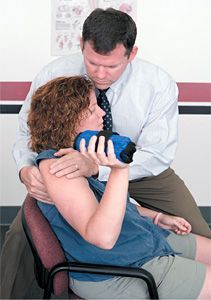
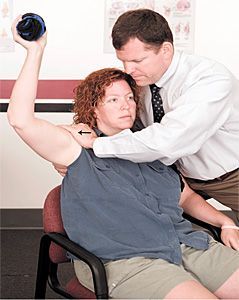
The Mulligan mobilization-with-movement technique is especially useful when a shoulder is painful when raised above 90 degrees abduction.1 The practitioner stands on the opposite side of the painful shoulder with one hand on the scapula and the thenar eminence of the other hand over the head of the humerus, avoiding the coracoid process. The patient is told to raise their arm in the scapular plane (30 degrees anterior to the coronal plane) as the practitioner maintains a posterolateral sustained glide.
Mulligan asks: "Is it a positional fault that inhibits pain free movement?"1 If the contacts are accurate, there will be no pain as the patient abducts the arm. A load can be added provided it does not increase the pain. (See Figures A and B.)6 He recommends that the patient "punch" the arm up for three sets of 10 and always emphasizes that there should be no pain during the treatment.
Harryman DT, Sidles JA, Clark JM, et al., The Humeral Head Translates on the Glenoid With Passive Motion. In: Hawkins R, Morrey B, Post M, editors. Surgery of the Shoulder. St Louis: Mosby, 1990:186-9.
Ludewig PM, Cook TA. Alterations in shoulder kinematics and associated muscle activity in people with symptoms of shoulder impingement. Physical Therapy, 2000;80:276-91.
Hammer W. Functional Soft Tissue Examination & Treatment by Manual Methods, 3rd Edition. Sudbury, MA: Jones & Bartlett 2007.
The proposed merger of the National Board of Chiropractic Examiners and Federation of Chiropractic Licensing Boards was approved by NBCE delegates and FCLB members at their respective annual meetings, held jointly in Atlanta, Ga., this year. Per the new bylaws, the new entity takes the NBCE name, with FCLB continuing as a department within NBCE. The federation will continue to enjoy Board of Directors representation on what will be a single, expanded board.
Before introducing subscapularis syndrome as an upper extremity analog, it is essential to revisit piriformis syndrome as a well-established example of myogenic pseudo-radiculopathy. Piriformis syndrome has long served as a clinical exception to disc-centric models of lower extremity pain and provides an important framework for understanding how deep muscular dysfunction can mimic radiculopathy in the absence of nerve root compression.
Pain has become the dominant language of musculoskeletal healthcare. Numeric pain-rating scales and symptom reports are routinely used as primary indicators of clinical success. But while pain reduction is meaningful, it is an incomplete and often misleading representation of recovery. This has real consequences for patient adherence, long-term outcomes, and how conservative care is perceived within the broader healthcare system.