Who is a better athlete - your average body-builder or Michael Jordan? Many people can lift heavy objects, but they are not good athletes. Why? Because they lack speed, power or the ability to change direction on a dime. Another example is from track and field. Why do you think the world's fastest runners rarely make good running backs or wide receivers in football? Because they only have straight-ahead speed, but lack the power and agility to stop and start or change directions. A football player hardly ever runs more than 30 yards on a play. This is why short, powerful bursts of speed define professional athletes in football, basketball, baseball and boxing.
Having power means an athlete can generate maximum strength in the shortest period of time. An athlete can be exceptionally strong, but lack significant explosive power if they are unable to apply their strength rapidly. Thus, athletes and strength/conditioning coaches should have a basic understanding of the relationship between the force of movement and the velocity of movement.
The Force-Velocity Relationship
Traditional strength training focuses on absolute force and motion, but does not influence the speed of force generation. In contrast, power training aims to reduce the time it takes to apply a set amount of force. This relationship between force and velocity and its effect on power explains why an athlete can be exceptionally strong, but lack significant power if they are unable to apply much of their strength over a short period of time. Think of a strong but slow, lumbering person and compare them to a cat-like, quick person. Who is the better athlete?
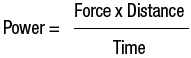
Power is related to force and time by this formula:
Similar to fine-motor-control training, the ideal force for generating power is when load is at approximately 30 percent of a one-repetition maximum (1-RM).1-3 Thus, the goal of power training is to increase the rate of force production. The main method to achieve this is plyometrics. Plyometric drills are both quick and powerful. They use a pre-stretch that involves the stretch-shortening cycle.4 Plyometric exercises usually involve jumping or upper-body drills using medicine balls and sometimes a rebounder.
The essence of plyometrics is that it involves exercise with the time spent on the ground minimized and the distance jumped maximized. This involves training both shock-absorption ability upon landing and spring or elastic recoil ability when jumping. If slow, static movements are emphasized, then dynamic stability, ability to change direction, and speed will not improve.
A myth about plyometrics is that the exercises are dangerous. The image of a person performing box squats and letting the knees pass forward of the toes during high-impact training has given all of plyometrics a bad name. However, if proper technique is emphasized and load remains low, plyometrics offers an unparalleled way to train the motor system to simultaneously enhance joint stability and power. This has been demonstrated in the rehabilitation of athletes following ACL injury.5
To absorb shock requires the skill of deceleration. To be able to spring requires the ability to change direction. Plyometrics is generally thought of as jumping or bounding training. The concept can be applied to agility work as well. Lateral running exercises such as the 20-yard shuttle drill or three-cone drill require tremendous power. In the 20-yard shuttle, an individual comes to a complete stop and changes directions twice while accelerating maximally between stops. This timed test is a functional power drill. The three-cone drill requires a smoother deceleration and control of one's center of mass (i.e., dynamic balance) combined with rapid acceleration. In both cases, deceleration, acceleration and change of direction are emphasized, making these ideal functional training exercises for sport.
Agility Tests and Training
According to Balyi, a key time for motor development for children is between the ages of 9 and 12.6-7 At this time, children are developmentally ready to acquire general overall sports skills that are the basis for healthy athletic development. This is the biological time before the maximum growth spurt during which there is a window of accelerated adaptation to motor coordination. This occurs within a chronological range, but is tied to the biological onset of the peak growth spurt, not an actual fixed age.3 Athletic excellence requires approximately 10 years of purposeful physical, mental and emotional training during this time frame.8 Knowledge of this can help in creating programs that avoid both emotional burnout and physical overuse injuries.
During this key period, a 75 percent training to 25 percent competition ratio is recommended.6-7 The ABCs of agility, balance, coordination and speed are emphasized in the training. As a child's growth spurt slows down, the ratio of training to competition can shift from 75:25 to 60:40.
In order to establish baselines for the functional development of the athlete, we can use a number of tests similar those used in the National Football League. These tests give the youth athlete, weekend warrior or elite athlete a yardstick by which to measure themselves and a goal for which to shoot. Tests include the vertical leap, broad jump, 20-yard shuttle and three-cone drill. Here are the fundamentals of the latter two:
The 20-Yard Shuttle Test
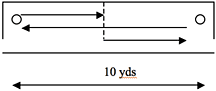
The 20-Yard Shuttle Test (aka the 5-10-5 test or pro agility test): tests explosiveness, how a player bends and changes direction, and body control.
Place two objects 10 yards apart.
Start at the midpoint (bottom of figure) with your feet and body facing straight ahead, so objects are to your left and right.
At the whistle, simply turn, cross over, and sprint toward one side or the other, touching the ground at the object (5 yards).
Turn and sprint to the opposite end line (10 yards).
Finish by turning and sprinting across your original starting position (5 yards).
Tips: Stay low in the first 5 yards, decelerate completely at each line, keep your feet under your body and finish hard through the line.
The Three-Cone Drill
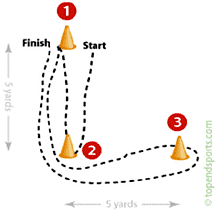
The Three-Cone Drill: Tests efficiency in changing direction moving left and right, explosiveness, balance, body control, and mobility.
Set up three cones in a triangle with each cone 5 yards apart.
Start in a ready position at the first cone.
When the whistle blows, sprint 5 yards ahead to cone 2 and touch it.
Run back to cone 1 and touch it.
Run around the outside of cone 2 to cone 3 and run around it from the inside.
Run around the outside of cone 2 and through the finish line at cone 1.
Tips: Stay low, decelerate at cones, utilize small, quick steps to navigate around cones, and finish hard through the line.
Balyi I, Hamilton A. "Long-Term Athlete Development: Trainability in Childhood and Adolescence. Windows of Opportunity, Optimal Trainability." www.sportdevelopment.org.uk/bayli20041.pdf
While cervical disc pathology can unquestionably produce radiculopathy, many patients presenting with arm pain, paresthesia or perceived weakness do not exhibit the clinical behavior of true nerve-root compromise. In these cases, failure to differentiate the primary pain generator may lead to unnecessary spinal injections, nerve ablation procedures or surgical consultation despite limited likelihood of benefit.
The New Jersey Board of Chiropractic Examiners has made a precedential decision, concurring with the Association of New Jersey Chiropractors' (ANJC) position paper on chiropractic X-ray guidelines. In plain terms, the board ruled, consistent with the ANJC position, that insurance companies cannot use medical X-ray rules or recommendations, like those written by the American College of Radiology (ACR), to decide whether a chiropractor's X-ray was necessary.
For decades, chiropractors have been told the answer to more professional referrals is simple: educate medical doctors about chiropractic. There is some truth in that advice; but it is also incomplete. The modern challenge is not simply getting another healthcare professional to know that chiropractors exist. It is becoming the kind of clinician (and building the kind of professional relationship) that makes collaboration easy and sustainable.