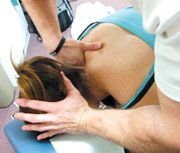
Identifying First-Rib Fixation Syndrome: Thinking Outside the Box
Perry Nickelston, DC, FMS, SFMA
Case 1: Patient X presents with chronic left-sided trapezius spasm and mid-back pain. Previous chiropractic, physical therapy and massage treatment provided minimal results.
Case 2: Patient Y presents with chronic shoulder pain. Surgery, physical therapy and chiropractic temporarily alleviated symptoms, but the pain has returned worse than ever.
Case 3: Patient Z presents with chronic cervical pain and radiculopathy into the left upper extremity. MRI results are normal and manipulation of the cervical and thoracic spine was unremarkable.
How can you help these patients? What are you going to do differently than all the other health care providers who treated these people? Look outside the proverbial box for a first-rib fixation syndrome. A majority of doctors will overlook this syndrome as part of their initial examination and diagnosis. This is unfortunate because an elevated first rib can cause a myriad of symptoms and complications, leaving a patient to suffer unnecessarily for years.
Symptoms of First-Rib Fixation Syndrome
Trapezius spasm
Neck pain
Headaches
Shoulder pain
Radiculopathy
Jaw pain
Mid-back pain
Paraesthesia
Chest and sternal pain
Anatomy and Mechanics
The primary components of the supraclavicular notch and muscular attachments to the first rib include: the anterior and medial scalenes, subclavius and serratus anterior. Secondary, kinetic movement muscles of the syndrome include: the pectoralis major/minor, sternocleidomastoid, trapezius, infraspinatus, subscapularis, supraspinatus, rhomboid major/minor, serratus posterior superior and the levator scapulae.
A superior rib develops in a person affected by a muscular-imbalance condition known as the upper crossed syndrome. In this syndrome, the subscapularis and infraspinatus are loaded with trigger points, resulting in weakness and the inability to keep the humeral head externally rotated and inferior. The humeral head translates superior and anterior, affecting the acromioclavicular joint and sternoclavicular joint pivot mechanics. The cervical spine becomes kyphotic and the patient develops rounded shoulders and a hyperkyphotic thoracic spine. The scalenes, serratus anterior and sternocleidomastoid overcompensate and develop active trigger points. Referred pain from these trigger points manifests as new and erratic symptoms. Due to the attachment of these spastic muscles on the first rib, superior elevation occurs. The trapezius has an instant reflex-guarding mechanism and goes into tightness and spasm. Compression of the brachial plexus and subclavian artery might now cause thoracic outlet syndrome.
Evaluation and Treatment
Ninety percent of your diagnosis should come from patient history. Your examination is designed to confirm your diagnosis. During the patient history, ask about sleeping habits. Elevated first ribs typically occur in patients who are stomach sleepers. They might sleep with one arm tucked under their head or sleep with minimal or multiple pillows. Extensive work in front of computers and the use of a mouse may result in micro-traumatic contracture of the trapezius. Patients will complain of constant dull, aching pain and tightness in the trapezius.
Hyperflexion/hyperextension injuries usually have a rib involvement. First-rib syndrome is mandatory for evaluation in all athletes, particularly tennis players and weight lifters. Almost every athlete is affected by one component of the syndrome. This should be a mainstay of your clinical evaluation in athletes.
During examination, palpate the supraclavicular notch for tenderness, spasm and edema. A patient will inherently pull away when you touch an elevated first rib. Look for the "jump sign." You will find active/latent trigger points in almost all of the muscles listed above, particularly the scalenes, SCM, and infraspinatus. X-ray the patient's cervical spine with AP, lateral and oblique views to rule out a possible cervical rib involvement.
The following is a list of effective treatment therapies. A combination gives you greater success in clinical outcomes. (Note: Therapy techniques are recommended prior to any manipulation.)
Laser therapy of the supraclavicular notch and all primary trigger points. Recommend dosage of 500 Joules in the notch and 250-500 Joules per trigger point. The cervical spine might need laser for relaxing the multifidus stabilizer muscles, allowing for a more effective and longer-lasting adjustment by reducing "muscle-memory splinting" reaction.
Soft-tissue mobilization per your technique (MFR, PNF, ART, TPT, etc.) on all the muscles listed above. Pay close attention to the anterior, medial, and posterior scalenes and the pectoralis major/minor.
Manipulation (adjustment) of the first rib. Speed is of utmost importance. Take a scissor stance on the opposite side of the rib involved. Laterally flex head to the involved side and find the tension point. Line of drive is superior to inferior and lateral to medial, toward the inferior angle of the opposite scapulae. Use a slight body drop and elbow torque with the contact hand to increase speed.
Adjustments of the cervical and thoracic spine per your technique.
EMS and heat of rhomboids and serratus posterior superior.
Scapular retraction exercises - Three sets of 15-20 reps daily with resistance bands.
Self-myofascial release with biofoam rollers on the shoulder, posterior capsule and thoracic spine three times per week.
Stretching of the pectoralis muscles.
Revision of sleeping habits. Prescribe a cervical pillow and exercise bands.
By taking a little extra time to investigate areas outside the focal point of pain, you can have a profound impact on a patient's quality of life. Remember, if you chase pain, you will forever be lost. Now you can be the one physician who gets to the root of a problem. Your patients will thank you for it.
While cervical disc pathology can unquestionably produce radiculopathy, many patients presenting with arm pain, paresthesia or perceived weakness do not exhibit the clinical behavior of true nerve-root compromise. In these cases, failure to differentiate the primary pain generator may lead to unnecessary spinal injections, nerve ablation procedures or surgical consultation despite limited likelihood of benefit.
The New Jersey Board of Chiropractic Examiners has made a precedential decision, concurring with the Association of New Jersey Chiropractors' (ANJC) position paper on chiropractic X-ray guidelines. In plain terms, the board ruled, consistent with the ANJC position, that insurance companies cannot use medical X-ray rules or recommendations, like those written by the American College of Radiology (ACR), to decide whether a chiropractor's X-ray was necessary.
For decades, chiropractors have been told the answer to more professional referrals is simple: educate medical doctors about chiropractic. There is some truth in that advice; but it is also incomplete. The modern challenge is not simply getting another healthcare professional to know that chiropractors exist. It is becoming the kind of clinician (and building the kind of professional relationship) that makes collaboration easy and sustainable.