We see many patients with complaints of low back, sacroiliac and hip pain or dysfunction. These patients need to be thoroughly examined and diagnosed so proper treatment can be started.
Several factors in the history and diagnostic evaluation can be helpful to properly place these patients in a category that will optimize their chance for recovery. With iliofemoral DJD, patients have pain in the anterior upper thigh, not the lateral hip around the greater trochanter and not posteriorally. Patients often take over-the-counter NSAIDs to help with the pain.
These patients lose the ability to extend, flex and internally rotate the hip. You often will see altered gait as this progresses. X-rays are helpful and you should routinely include the iliofemoral joints on your APLP view. You will see characteristic sclerosis, joint-space narrowing and possibly spurring. You need to rule out avascular necrosis. X-rays may look similar for DJD and AVN. MRI is helpful to differentiate AVN from hip DJD, so when in doubt, have the MRI done.
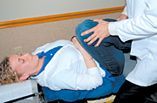
Figure 1: Passively flex the patient's hip. You are looking for pain, stiffness, lack of ability to avoid externally rotating the hip as signs of hip joint pathology or dysfunction. You also can check the other leg for flexion as a possible indicator of hip flexor tightness.
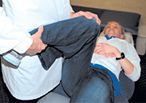
When patients are examined in the supine position, passive flexion of the hip often is uncomfortable, and they will tend to want to externally rotate the hip as you bring the hip up into flexion. (Figure 1) In this same supine position, forced internal rotation of the hip often is painful, and they will point to the anterior upper thigh. (Figure 2) Passive stretching of the external hip rotators will cause a pinching in the anterior upper thigh with hip DJD. (Figure 3) You often can see hypotonic glutes on the side of the degenerated hip.
If the iliofemoral DJD is moderate to advanced, adjusting the iliofemoral joint often will aggravate it (especially initially), so be careful and light with your adjustments. Check the sacroiliac joints closely. Stretch in a relatively pain-free zone, as this can be helpful. Stretching too hard will tend to aggravate. Often, strengthening of the glutes will help compensate for the bad hip. Anti-inflammatory nutrition including essential fatty acids, ginger, turmeric or nexutrine can be helpful. Glucosamine with chondroitin is routinely used for these patients.
Figure 2: The doctor is forcing internal rotation of the patient's right hip, looking for restriction and/or pain. Tight external hip rotators or DJD of the iliofemoral joint are common causes of pain or restriction with this screening test.
An orthopedic surgeon can evaluate for hip replacement or resurfacing if degenerative changes have progressed too far to allow for conservative management. Some patients need a total hip replacement. Quite a few patients, especially younger ones, now have hip resurfacing - surgeons put a cap on the top of the head of the femur and then a cap on the socket of the acetabulum. This does not particularly shorten the recovery time, but does allow for greater activity after recovery. These patients typically are able to do most activities (short of running marathons) after the hip resurfacing is well-healed.
Chiropractors routinely see these patients in their offices and will see more and more of them as baby boomers age. We are ideal for treating mild to moderate degenerative changes in the hips. We are ideal for screening patients with severe osteoarthritis and getting them connected with a qualified orthopedic surgeon, if a hip replacement or resurfacing is required.
We can help prevent many of these degenerative conditions by screening our younger, healthier patients with an excellent history and functional exam. A patient presenting with, for example, low back pain needs a thorough functional exam that would include hip screens such as those described above, along with a modified Thomas test for shortening of the hip flexors and TFL. These muscle imbalances lead to abnormal joint-compression strategies, irregular wear on the joint and eventual DJD.
Figure 3: This tests for tightness of the external hip rotators and also helps screen for iliofemoral DJD. With DJD, the patient will have anterior pain in the inguinal area.
Common findings leading to DJD of the iliofemoral joint include genetics, previous injury, abnormal biomechanics, poor muscle balance and a pro-inflammatory diet. We can do little about genetics directly, but we can evaluate the patient for what we can do something about. Is there joint dysfunction in the sacroiliac area, iliofemoral joint or foot/ankles? Is there excessive tightness of the external hip rotators and hip flexors blocking normal internal rotation and hip extension? Are the glutes functionally weak and not supporting the area as required? Do patients need to alter their diet and supplement regimen toward a more anti-inflammatory diet with emphasis on fruits, vegetables, raw nuts, grass-fed meat and wild fish? DCs are perfectly suited to help prevent this problem and manage these patients.
Building on a historic March 2026 meeting between Make America Healthy Again and chiropractic leadership, MAHA has announced the launch of the MAHA Chiropractic Hub, “a coordinated national partnership uniting MAHA Center, MAHA Action, and the chiropractic profession, including national associations, state organizations, practitioners, educators, researchers, and patient advocates. The Chiropractic Hub will advance federal policy, expand patient access, and build broad public support for chiropractic care across America.”
The chiropractic profession is confronting one of the most significant federal regulatory threats it has faced in decades. A new U.S. Department of Education (ED) accountability framework – commonly referred to as the “Do No Harm” (DNH) regulation – could place many chiropractic programs at risk of losing access to federal financial aid (student loans), potentially reshaping the future of chiropractic education and workforce development across the United States.
Pain has become the dominant language of musculoskeletal healthcare. Numeric pain-rating scales and symptom reports are routinely used as primary indicators of clinical success. But while pain reduction is meaningful, it is an incomplete and often misleading representation of recovery. This has real consequences for patient adherence, long-term outcomes, and how conservative care is perceived within the broader healthcare system.