It's illogical to make definitive statements about the mechanical and neurobiological effects of spinal adjustments, as we simply do not have adequate evidence to support such a position. The term subluxation typically is characterized as a spinal bone that has moved out of position relative to the adjacent vertebrae.
Patients often will say they feel "out" and need an adjustment to get realigned. Most patients and docs feel that a successful adjustment is one that is associated with the cracking sound of spinal joint cavitation. While there is no evidence to suggest that an adjustment must be accompanied by a cavitation, we all tend to like it better and feel more confident that a meaningful event occurred when we hear the cavitation.
The cracking sound often is followed with patient/doctor comments about how the vertebra "popped" or "moved" back into place or alignment, or the joint was reset. In short, numerous and various terms are used to describe how misaligned vertebrae are "adjusted back into place."
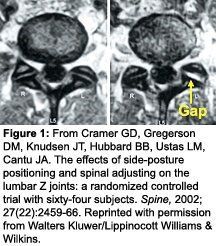
If, in fact, the adjustment reset the vertebral position, we should be able to see such a change on X-ray or MRI. Unfortunately, very few attempts have been made to demonstrate this outcome. However, for those who believe that "bones pop back into place," there is strong contrary evidence. In 2003, Dr. Greg Cramer and colleagues published the results of a study that suggested a very different outcome occurs with lumbar spine adjusting.1
Lumbar MRIs were first taken of subjects in a side-posture position to visualize both zygapophyseal joints (Z-joints). Then subjects were given a side-posture adjustment and a second MRI was taken. Figure 1 illustrates the pre- and post-adjustment images in the Z-joints.
Clearly, we can see that the left lumbar Z-joint gapped as a consequence of an adjustive thrust. We are told that the right Z-joint was simultaneously moved into a closed packed position.1 Each change was transient in nature. This biomechanical outcome of spinal adjusting supports Sandoz's hypothesis published back in 1976.2
Based on this image, we clearly can see that adjustments don't put bones back into place. If anything, just the opposite occurs in the short term. In addition to moving vertebrae temporarily out of position, we also know that adjustments improve movement asymmetries3-7 and reduce spinal muscle excitability,8,9 and it's well-established that adjustments reduce pain for many patients, which is why it's recommended in the various guidelines for treating low back pain.
Such outcomes of spinal adjusting should lead us to consider the possible nature of subluxation in a different light than the traditional view that subluxation is a bone out of place, which causes nerve interference. In fact, the evidence suggests the opposite.
References
Cramer GD, Gregerson DM, Knudsen JT, et al. The effects of side-posture positioning and spinal adjusting on the lumbar Z joints: a randomized controlled trial with sixty-four subjects. Spine, 2002;27(22):2459-66.
Sandoz R. Some physical mechanisms and effects of spinal adjustments. Ann Swiss Chiropr Assoc, 1976;6:91-141.
Carrick FR. Cervical radiculopathy: the diagnosis and treatment of pathomechanics in the cervical spine. J Manipulative Physiol Ther, 1983;6:129-37.
Nansel DD, Cremeta E, Carlson J, Szlazak M. Time course considerations for the effects of unilateral lower cervical adjustments with respect to the amelioration of cervical lateral-flexion passive end-range asymmetry. J Manipulative Physiol Ther, 1990;13:297-304.
Nansel D, Jansen R, Cremata E, et al. Effects of cervical adjustments on lateral-flexion passive end-range asymmetry and on blood pressure, heart rate and plasma catecholamine levels. J Manipulative Physiol Ther, 1991;14:450-6.
Nansel DD, Peneff A, Quitoriano J. Effectiveness of upper versus lower cervical adjustments with respect to the amelioration of passive rotational versus lateral-flexion end-range asymmetries in otherwise asymptomatic subjects. J Manipulative Physiol Ther, 1992;15:99-105.
Nansel DD, Waldorf T, Cooperstein R. Time course effect of cervical spinal adjustments on lumbar paraspinal muscle tone: evidence for facilitation of intersegmental tonic neck reflexes. J Manipulative Physiol Ther, 1993;16(2):91-5.
Lehman GJ, McGill SM. The influence of a chiropractic manipulation on lumbar kinematics and electromyography during simple and complex tasks: a case study. J Manipulative Physiol Ther, 1999;22:576-81.
Lehman GJ, McGill SM. Spinal manipulation causes variable spine kinematic and trunk muscle electromyographic responses. Clin Biomech, 2001;16:293-9.
The proposed merger of the National Board of Chiropractic Examiners and Federation of Chiropractic Licensing Boards was approved by NBCE delegates and FCLB members at their respective annual meetings, held jointly in Atlanta, Ga., this year. Per the new bylaws, the new entity takes the NBCE name, with FCLB continuing as a department within NBCE. The federation will continue to enjoy Board of Directors representation on what will be a single, expanded board.
Before introducing subscapularis syndrome as an upper extremity analog, it is essential to revisit piriformis syndrome as a well-established example of myogenic pseudo-radiculopathy. Piriformis syndrome has long served as a clinical exception to disc-centric models of lower extremity pain and provides an important framework for understanding how deep muscular dysfunction can mimic radiculopathy in the absence of nerve root compression.
Pain has become the dominant language of musculoskeletal healthcare. Numeric pain-rating scales and symptom reports are routinely used as primary indicators of clinical success. But while pain reduction is meaningful, it is an incomplete and often misleading representation of recovery. This has real consequences for patient adherence, long-term outcomes, and how conservative care is perceived within the broader healthcare system.