The "England" Case and the "Wilk" Case: A Comparison, Part 2
Joseph Keating Jr., PhD
Editor's Note: Part one of this article appeared in the Sept. 10 issue
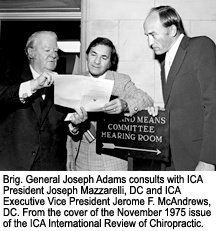
Perhaps not surprisingly, some DCs and their advisors were reluc-tant to accept the challenge Dr. Wilk offered to the profession as he toured the nation in 1975, seeking support for his plan to sue the AMA and its allies. One memorable incident (a story told by the late Dr. Jerry McAndrews) involved Brig. General Joseph Adams, legislative consultant and lobbyist for the International Chiropractors' Association (ICA). The ICA's governing body, the Board of Control, was deliberating whether to support Dr. Wilk's initiative in bringing suit against AMA, et al. General Adams had come late to the meeting and stood quietly listening for a few minutes after entering the room. He asked for the floor and exclaimed, "I can't believe my ears," (or words to this effect). "I have listened to you people bellyache for years about the abuse you've received from the medical establishment, yet now you have to debate whether to endorse this lawsuit? Dr. Wilk is not even asking for money - he only requests your moral support!" Within minutes, the ICA voted to stand by the complaint in federal court.
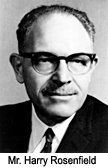
The ICA's relatively rapid en-dorsement of the Wilk case was not matched at the headquarters of the American Chiropractic Association (ACA). Harry Rosenfield, chief legal counsel for the national membership society, believed that another attack upon the medical monopoly through the courts was not wise. The England case had paraded all the worst in the chiropractic profession past the jury (and the public), as exemplified by the contents of one of the books the AMA had surreptitiously supported: Ralph Lee Smith's At Your Own Risk: The Case Against Chiropractic.1
Rosenfield anticipated (as it turned out, correctly) that the same treatment was likely if the Wilk case were pursued. His resistance to Dr. Wilk's strategy delayed the ACA's endorsement and severely inhibited the success of fundraising for the case.2
It was not that the ACA's attorney did not understand the important differences between the England case and the Wilk case. The former was a quest to establish licensure through judicial mandate. The latter was an effort to use the Sherman Anti-Trust Act in order to put an end to the illegal conspiracy and economic boycott orchestrated by the AMA's Committee on Quackery. The focus of the plaintiff's case in Wilk, et al. v. AMA, et al. was not the merits of chiropractic, but rather the AMA's campaign to "contain and eliminate" the chiropractic profession: a campaign that illegally limited competition in the health care marketplace. Rosenfield appreciated the distinction. What he dreaded was a rehash of the public humiliation the profession had undergone in New Orleans in 1965 - something that mattered a few years later when the U.S. Congress was considering whether to include DCs in the Medicare program.3 However, bitter sentiments against Mr. Rosenfield linger.4-5
The first trial in the Wilk case may be seen as something of an ironic vindication for the ACA's attorney. By the time the trial ended (1981), the ACA had long since become a strong supporter of the antitrust lawsuit. The verdict was rendered by a panel of citizens who listened to the economic arguments presented by Mr. George McAndrews, chief attorney for Dr. Wilk and associates. The jury also listened to the defendants' recitation of the same sorts of fantastic and dubious clinical claims made by technique gurus and practice consultants, and the same greedy and unethical strategies recommended by those who instructed DCs on how to build their practices. In a post-trial interview of a few of the jurors, Mr. McAndrews learned that notwithstanding the unjustified police powers exercised by the AMA, et al., some of the jurors believed that several of the DCs brought to their attention belonged in jail. Although the trial prompted the AMA to eliminate its "ethical" ban against professional collaboration between its members and "unscientific" practitioners, once again the DCs had defeated themselves.
In the second trial, the plaintiffs waived punitive damages in exchange for a trial by magistrate. This strategy required Judge Getzendanner to serve as the sole arbiter between the DCs and the forces of political medicine. After reviewing all the evidence provided by the plaintiffs and defendants, she had to decide whether or not commerce had been illegally restrained, but she did not have to consider the financial magnitude of the economic loss to the defendants. Once again, the evidence included the sorry tales of DCs' sins against reason and patient welfare. Once again, barbaric stories were recounted about the neglect of the medical needs of patients for no other reason than the "taint" of quackery (e.g., a patient referred by a DC). The judge found in favor of the DCs in 1987, and her ruling was sustained by higher courts in the next few years. She mandated that the AMA publish her ruling in their premier periodical, JAMA, so the seriousness and extent of the medical society's misbehavior would come to the attention of all MDs throughout the land.
Fifty years ago, Dr. Jerry England and associates went to court to present the grievances that chiropractors held against political medicine in Louisiana. Almost 20 years later, Dr. Chester Wilk and associates commenced a similar effort in the federal court in Chicago. These two initiatives consumed great time and energy on the part of plaintiff DCs and their supporters throughout the profession. These cases also brought shame upon the profession when the greedy and unethical practices of a number of DCs were held up to the scrutiny of judges and juries. Defeat came to England, et al., in part because of a faulty strategy in seeking licensure through the courts rather than the legislature. Victory eventually came to Wilk, et al., in part because of the grievousness of political medicine's abuse of the public trust and in part because the dedicated and brilliant work of DCs' legal counsel outweighed the shameful behavior of some in the chiropractic profession.
This writer feels that the lessons to be learned from studying the England case and the Wilk case are pretty clear. Unfortunately, some of these lessons do not yet concern a vocal majority of DCs or MDs. Indeed, public discussion of these issues still is considered politically incorrect in many corners of the community of health care providers. Notwithstanding any remedies applied by the courts, the losers - in the Wilk case, the England case and in much of the political feuding between DCs and MDs - are the patients. Who will stand up for patients and require that allopathic and chiropractic doctors work together in the public's best interest? Perhaps another legal battle will be needed; it will not be pretty.
References
Smith RL. At Your Own Risk: The Case Against Chiropractic. New York: Pocket Books, 1969.
Holmberg W. Notes on the Wilk case, unpublished (June 2007).
Wardwell WI. Chiropractic: History and Evolution of a New Profession. St. Louis: Mosby, 1992.
Sportelli L. E-mail to J.C. Keating, June 10, 2007.
Wilk CA. Medicine, Monopolies and Malice. Chicago: the author, 1996.
The proposed merger of the National Board of Chiropractic Examiners and Federation of Chiropractic Licensing Boards was approved by NBCE delegates and FCLB members at their respective annual meetings, held jointly in Atlanta, Ga., this year. Per the new bylaws, the new entity takes the NBCE name, with FCLB continuing as a department within NBCE. The federation will continue to enjoy Board of Directors representation on what will be a single, expanded board.
Before introducing subscapularis syndrome as an upper extremity analog, it is essential to revisit piriformis syndrome as a well-established example of myogenic pseudo-radiculopathy. Piriformis syndrome has long served as a clinical exception to disc-centric models of lower extremity pain and provides an important framework for understanding how deep muscular dysfunction can mimic radiculopathy in the absence of nerve root compression.
Pain has become the dominant language of musculoskeletal healthcare. Numeric pain-rating scales and symptom reports are routinely used as primary indicators of clinical success. But while pain reduction is meaningful, it is an incomplete and often misleading representation of recovery. This has real consequences for patient adherence, long-term outcomes, and how conservative care is perceived within the broader healthcare system.