One of the most common injuries to afflict athletes of any skill level is shoulder pain. From the "weekend warrior" to the professional athlete, to the average fitness buff getting into shape; no one is immune to injury. Beyond obvious traumatic onset, very few clinicians understand the mechanism for acute shoulder injury and chronic pain. The majority of shoulder problems develop from microtraumatic events occurring due to poor joint biomechanics and muscular movement imbalances. It is important for the clinician to be aware that shoulder pain is usually a symptom of deeper problems that, unless corrected, may lead to total functional impairment.
Clinical Perspective
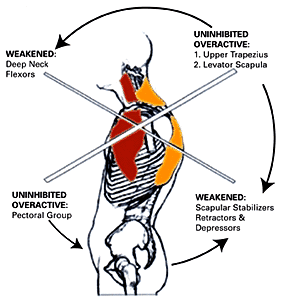
Microtraumatic shoulder injuries happen in a predictable pattern: impingement > tendonitis > bursitis > rotator cuff injury. This leads us to the upper crossed syndrome (UCS). This syndrome is based on Dr. Vladimir Janda's pioneering work in researching and understanding the predictable pattern of muscular compensation and postural imbalances in the body. He postulated that faulty movement patterns on a poor postural base contribute to habitual overuse in isolated joints, while they minimize normal movement in others, thus creating a self-perpetuating cycle of dysfunction and eventual injury.
UCS leads to a forward head posture causing strain to the muscular attachments of the shoulder and shoulder blade. An anterior tilt and abduction ("flaring out") of the shoulder blades occurs, producing a rounded shoulder appearance. Due to the rounded shoulder posture, the mechanical axis of rotation of the glenoid fossa (shoulder socket) becomes altered. The humerus (arm) now requires additional stabilization from muscles that typically are quiet: the levator scapulae, upper trapezius, subscapularis, pectoralis minor and supraspinatus muscles. Postural overdevelopment of these muscles creates a deltoid shear (crossing of rotator cuff under AC joint), leading to shoulder impingement, tendonitis and bursitis syndromes.
Proper rehabilitation of the shoulder must include protocol for reversing the upper crossed syndrome. So, how do you do that? I have found the following program to be the most effective form of rehabilitation treatment.
Treatment Protocol
Due to chronic shortening, tightness and weakness in the primary stabilizers of the shoulder (supraspinatus, infraspinatus, teres minor and subscapularis), muscular adhesions and trigger points develop that must be removed before active/passive stretching. Failure to do so will result in stretch-reflex reciprocal inhibition and increased loss of muscle tone. Performing four to six sessions of myofascial release and trigger-point therapy usually is sufficient. Check all muscles in the UCS chart above. The most commonly affected muscles are the scalenes, pectoralis minor, infraspinatus and subscapularis.
Here are other aspects of this treatment protocol.
Ultrasound the infraspinatus or subscapularis, depending on the most painful area of palpation and trigger-point referral pattern. Laser therapy also may be used. Typical dose is 170 Joules per point.
Shoulder-blade retraction exercises for building the serratus anterior/posterior, trapezius and rhomboids, and for restoring scapular stabilization strength.
Rotator cuff protocol: External rotation (three sets of 12-15 repetitions). Internal rotation not recommended due to the tendency of the subscapularis to become tight and overdeveloped.
Y,T,W,L exercises on the stability ball to restore and enhance muscular recruitment patterns.
Manipulation of the 5th and 6th cervical vertebrae and upper thoracics. Check the first rib for superior elevation, which can cause faulty AC joint mechanics, impingement syndrome and unrelenting trapezius muscle spasm.
At-home treatment consists of rest and TENS to control pain. The tennis ball massage technique on the trapezius and infraspinatus (five to seven times per day) is extremely beneficial for breaking up active/latent trigger points. Self myofascial release with foam rollers on the upper back, lower latissimus dorsi, teres major/minor and infraspinatus will accelerate healing.
Most patients will be asymptomatic by the sixth visit and will demonstrate significant improvement in functional performance. The length of time it took to develop the problem is an indicator of how long you will need to work on correcting the faults before results will be felt. Don't forget that pain is often only the tip of the iceberg, directing you to the real underlying problem: upper crossed syndrome.
While cervical disc pathology can unquestionably produce radiculopathy, many patients presenting with arm pain, paresthesia or perceived weakness do not exhibit the clinical behavior of true nerve-root compromise. In these cases, failure to differentiate the primary pain generator may lead to unnecessary spinal injections, nerve ablation procedures or surgical consultation despite limited likelihood of benefit.
The New Jersey Board of Chiropractic Examiners has made a precedential decision, concurring with the Association of New Jersey Chiropractors' (ANJC) position paper on chiropractic X-ray guidelines. In plain terms, the board ruled, consistent with the ANJC position, that insurance companies cannot use medical X-ray rules or recommendations, like those written by the American College of Radiology (ACR), to decide whether a chiropractor's X-ray was necessary.
For decades, chiropractors have been told the answer to more professional referrals is simple: educate medical doctors about chiropractic. There is some truth in that advice; but it is also incomplete. The modern challenge is not simply getting another healthcare professional to know that chiropractors exist. It is becoming the kind of clinician (and building the kind of professional relationship) that makes collaboration easy and sustainable.