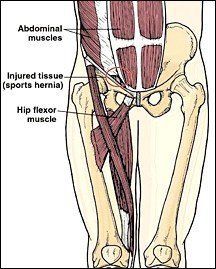
I have been a runner and weightlifter for more than 20 years. Five weeks ago, I rotated, bent forward and lifted my lawnmower to put it in my trunk. Within a few minutes, I began to have right-sided lower back pain and pain in my front abdominal area. Now after five weeks, it has improved maybe 20 percent. The pain has leveled off and is not getting better and not getting worse. I can bike with no pain but when I run, I feel deep pressure pain in the front lower abdominal region. There is no bulging in the area. I know that it is not a groin muscle pull because when I stretch the area, there is no pain. It's more in the abdomen than it is in the front hip muscles. When I try to run, the pain in my front right abdomen prevents me from striding out at first and then after five minutes or so its starts to loosen up a bit. The right-side back pain is pretty much a low-grade pain in the right side of the back of my pelvis. I don't think the two pains are related to each other, but they did start as a result of the lawnmower lifting. Every Sunday I like to run with several friends of mine at the mountain. It has been getting increasingly difficult, however, to run at our standard pace due to my abdominal pain. Every time I mention my condition to running buddies, they tell me to call Dr. Batchelor for help. I wanted to first send this e-mail to see if you have treated this type of condition before.
It seems that when most of my patients enter the clinic with an injury, I have at some time in the past suffered that same injury. It might not have been good for me, but it is good for the patient because it helps me treat the patient more effectively. Being a doctor of chiropractic involves a great amount of physical activity in the treatment of patients. My own sports hernia injury occurred from treating a few patients who weighed more than 330 pounds apiece. I weigh 160 pounds, so when a patient of mine is twice my weight, my body has to request additional resources and help from other structures and muscles. I can handle patients up to about 280 pounds, but in these extreme situations, where patients are more than 330 pounds, my physical structure is pushed past its limit and things can begin to rip or break. I have had a sports hernia, my father has had one, my brother has had one, and many of my friends have had one, too.
What Is a Sports Hernia?
A sports hernia is a tear in the muscles of the lower abdomen. It causes pain in the lower abdomen or groin. Men get it more than women. The pain from a sports hernia usually begins gradually. Over time, athletic activity involving lifting, twisting and straining can cause microscopic tears in the muscle and fascia. The runner who sprints frequently is more likely to get it than the distance runner.
Symptoms are varied but usually involve lower abdominal pain, groin pain or pain just on one side of the lower abdomen; the pain usually is worse with coughing or sneezing. To diagnose it, I will take a history and do a physical exam. The patient will have tenderness in the lower abdomen and at the top of the groin. Some tests might be done to rule out other conditions that cause groin pain. I will rule out inguinal and other types of hernias. The initial treatment for a sports hernia involves rest, chiropractic physiotherapy, a special support belt, and special exercises. With proper treatment and the best scenario, it will take a few weeks for symptoms to go away. Without treatment, it may take two to six months or much longer.
At home, an ice pack is used on the area for 20 to 30 minutes, three to four times a day to minimize the discomfort. In rare instances, if rest, chiropractic physiotherapy, etc., do not relieve symptoms, surgery should be performed. During surgery, the lower abdominal muscles and connective tissue are released and reattached and some hip muscles are loosened.
How Can You Prevent a Sports Hernia?
Flexibility and strength, along with avoidance or activities that overstress the abdominal musculature, are the keys to preventing a sports hernia. Sometimes there simply is an inherent weakness in an area of the abdomen. It may be genetic or acquired over time. A good idea is to strengthen the abdominal area and also stretch it gently. Most people who do sit-ups or pelvic tilts do not stretch the abdominal muscles. A good stretch for the abdomen is accomplished by lying on the stomach and stretching with the pelvis on the floor and the upper body up in the air, using the arms as support. Several yoga positions stretch the abdomen effectively.
My goal as a doctor who treats athletic injuries is to return the patient to his or her sport or activity as soon as is safely possible. If the patient returns too soon, it may worsen the injury, which could lead to permanent damage. Everyone recovers from injury at a different rate. You should not rely solely on the amount of time that has passed since the initial injury. When it's ready, you will know it. Don't rely on how many days or weeks it has been since the injury occurred. If the condition has been present for a long period of time andthe patient has continued to run and work out, it will take much longer to rehab.
I have had many runners tell me they have a race scheduled in a set number of weeks and they need to have the area fixed by that time. This is not a logical way to rehabilitate an injury. The patient can return to the activity when he or she can bend at the waist to touch their toes and straighten their back without pain. The patient should be able to do a sit-up or abdominal crunch without pain. Trying to return to the activity too soon will only cause more damage.
The proposed merger of the National Board of Chiropractic Examiners and Federation of Chiropractic Licensing Boards was approved by NBCE delegates and FCLB members at their respective annual meetings, held jointly in Atlanta, Ga., this year. Per the new bylaws, the new entity takes the NBCE name, with FCLB continuing as a department within NBCE. The federation will continue to enjoy Board of Directors representation on what will be a single, expanded board.
Before introducing subscapularis syndrome as an upper extremity analog, it is essential to revisit piriformis syndrome as a well-established example of myogenic pseudo-radiculopathy. Piriformis syndrome has long served as a clinical exception to disc-centric models of lower extremity pain and provides an important framework for understanding how deep muscular dysfunction can mimic radiculopathy in the absence of nerve root compression.
Pain has become the dominant language of musculoskeletal healthcare. Numeric pain-rating scales and symptom reports are routinely used as primary indicators of clinical success. But while pain reduction is meaningful, it is an incomplete and often misleading representation of recovery. This has real consequences for patient adherence, long-term outcomes, and how conservative care is perceived within the broader healthcare system.