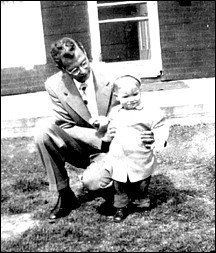
In the picture below, you see a young man with his son. Both are dressed up in Easter church clothes, fit for a cool and breezy early spring day in Ohio, circa 1953. After many months of sleep, the grass is bright and tender again, back to growing tough and fast enough for weekly mowing for the rest of that young man's life. The little guy was some help for a few brief years before wandering off on his destiny quest. A good father is pretty much a lopsided deal favoring sons and daughters: love, lead and let them go.
One of the two men is my father; I am the other. My father grew up with dreams and expectations of attending Massachusetts Institute of Technology, as his father, a Cornell graduate of 1915 or so, had promised. From fates, choices and his own father's early death, he ended up making a life and a living with his hands.
Dad worked as a carpenter, farmer, tree nurseryman and landscaper, and designed and built his own home. I handed him a wrench, hammer or screwdriver as he tore down engines, hooked up plows, repaired and installed electrical fixtures, fixed pumps and furnaces, and soldered, welded or replaced leaky pipes.
Dad was skilled in geometry and mathematics, and helped me with homework. But it was his ability with his hands that I admired. His hands grasped a kind of genius. Ideas were communicated better by pencil on paper. The complexities of carburetors could be spoken and heard, but when my father held one and turned it over and around in his hands, it quickly revealed its secrets. But like so many of his "greatest generation," he wanted his children to have a better life than he had - and for some reason, this came to mean a preference for using your head instead of your hands.
For several decades now, American culture equates handwork to unskilled work. Manual mostly means menial - tasks no one else wants to do - and manual dexterity is associated with dullness. This is a very timely issue: Some say Mexicans come to the U.S. to do work "Americans won't do," such as washing windows, throwing picks and shovels, washing dishes and cooking. Are Americans really less industrious?
As every chiropractor knows, working with your hands is different from mental work. Hands can work even faster than eyes and mind can follow. According to UCSF surgeon Frank R. Wilson, author of The Hand: How Its Use Shapes the Brain, Language, and Human Culture, a pianist is the summit of human achievement because of his or her ability to direct 400 muscle contractions per second, all in a single, purposeful action to produce music. Dr. Wilson1 proposes that the evolutionary gift of the human hand over 3 million years ago forced our brains to grow to direct and control this remarkable tool. Language and reasoning were just byproducts of a brain designed for handedness. Neither apes nor clever raccoons have hands like human ones. The human hand was made to sense and assess, control and force, and then caress and heal. This human hand is the product of anatomy and innervations unique in life.
Dr. Wilson says children need their hands to form their minds. Drawing, scribbling, coloring, building and stacking all give us a sense of proportion and space, and lay the neural foundation for the symbolic and abstract knowledge so prized in today's job economy. Waldorf schools recognize this and allow exploration of objects and space before turning students loose on language. Waldorf teachers believe the brain is not ready to read and write until one is settled in space, time and body - a feat only neurologically possible at about 10 years old. Thus a "body" of knowledge can only become knowledge embodied after the nervous system has a strong enough container for reasoning and language.
The Wilson hypothesis also puts a minor dent in the popular notion of mind-body. American mind-body dualism assumes minds affect bodies, and largely ignores how bodies affect our minds. This is a bias we are so used to that we don't even notice it. It stems from an ongoing love affair with the brain as our main source of power and identity. Bodies just lug around and protect our brains.
An equally intriguing idea is that the musculoskeletal system expresses our identity, and that our brains, stomachs and eyes see to it we have the requisite stuff needed to accomplish our mission. It is our hands that make us human, not our brains. Our brains are mere servants of the hands.
Prejudice against touch and hands goes back many years. In medieval times, true physicians could not touch blood; that was unclean. Surgeons, however, could touch blood and bodies - but then, they never held the prestige of the physician. Today, physicians and surgeons get along just fine. Touching patients minimally for taking data is still the rule. Health care professions that are more probative and that delve deeper into physical pain and problems with hand intelligence are still at the bottom of the health care ladder.
Then there is a human genetic indifference for the physical body as only a temporary container for consciousness. This is a common theme in all religions of the world: the illusion of life and an afterlife in heaven. As Paul Bloom of Yale University explains in the December 2005 issue of TheAtlantic Monthly,2 an adaptive mistake in human evolution gives us an inborn comfort with the idea of a consciousness as being separate and separable from bodies. Dr. Bloom suggests we are predisposed to believe in the supernatural, since bodies and minds appear to lead separate lives and meet different ends. But there are other, more basic and immediate interpretations of Dr. Bloom's data: that breaking the body away from the mind only leads us to fragmented views of ourselves by our healers and ourselves.
Hands to the Rescue
Hand consciousness is different. Problems can be found and solved without all of the posturing and judgments of the mind. Anyone who has ever had the good fortune to go to a chiropractor who earned his DC degree in the 1950s or 1960s knows what I am talking about: hands that find knots before they become lesions; that find minor imbalances before they require major surgery. Something is settled deep within when hands of that high level of development find and know us without X-rays and blood tests, and then improve our health status in just moments. This is the genius of chiropractic; a genius perhaps too easily dismissed when lured onto the mental, top-down, medical and third-party-paying battlefield.
Growing up with a hands-on genius like my father makes me wonder why there is such a cultural emphasis on working with the head instead of the hands. Working with your hands - sometimes called making an honest living, because you can see and count your accomplishments - is on the decline, even though it is the most difficult American work to outsource. It's hard to treat patients, fight fires, build your homes, fix your toilet, and arrest criminals from a call center in India.
In regions where medical physicians and specialists are less available or less interested in living, the small-town chiropractor provides some admirable and important portion of community health care. And yet today, we encourage our children to avoid working with their hands, to be accountants, doctors, lawyers and such.3 Hands train our minds. Hands can know what our minds may never grasp, grip and articulate. My father's hands first dazzled me with how the physical world can be manipulated and changed. For that, I am eternally grateful.
References
Wilson FR. The Hand: How Its Use Shapes the Brain, Language, and Human Culture. New York: Vintage Books, 1998.
Bloom P. Is God an accident? The Atlantic Monthly, December 2005;296(5).
Lyrics for "Mammas, Don't Let Your Babies Grow Up to Be Cowboys," by Willie Nelson.
The proposed merger of the National Board of Chiropractic Examiners and Federation of Chiropractic Licensing Boards was approved by NBCE delegates and FCLB members at their respective annual meetings, held jointly in Atlanta, Ga., this year. Per the new bylaws, the new entity takes the NBCE name, with FCLB continuing as a department within NBCE. The federation will continue to enjoy Board of Directors representation on what will be a single, expanded board.
Before introducing subscapularis syndrome as an upper extremity analog, it is essential to revisit piriformis syndrome as a well-established example of myogenic pseudo-radiculopathy. Piriformis syndrome has long served as a clinical exception to disc-centric models of lower extremity pain and provides an important framework for understanding how deep muscular dysfunction can mimic radiculopathy in the absence of nerve root compression.
Pain has become the dominant language of musculoskeletal healthcare. Numeric pain-rating scales and symptom reports are routinely used as primary indicators of clinical success. But while pain reduction is meaningful, it is an incomplete and often misleading representation of recovery. This has real consequences for patient adherence, long-term outcomes, and how conservative care is perceived within the broader healthcare system.