Symptoms of Lower Back Pain May Be a Medical Emergency
Deborah Pate, DC, DACBR
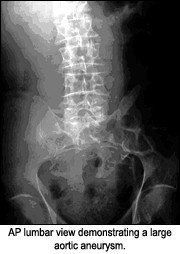
This AP lumbar view is of a 75-year old male with symptoms of lower back pain for several weeks. History is unremarkable, except that he was a smoker, but quit some 20 years ago. He has had back pain in the past, which resolved with treatment and rest. His present symptoms just are not resolving, and he hasn't experienced any relief from previous remedies that helped him in the past. Would you have taken the lumbar films before treating him? I think if you took the films you would be very concerned about the obvious aneurysm, which is nicely outlined by the atherosclerotic calcific plaquing.
Men over 60 have a higher incidence of aneurysms - about 10 percent. In men that smoke or have a history of smoking, the statistics seem to double, depending on the clinical study. Ninety percent of aortic aneurysms occur in the abdominal region.
A tear in the inner wall of the aorta generally occurs near the aneurysm. Blood then goes through the torn area, dissecting the wall and creating a new channel. The tear and creation of that new channel can be contained within the outer wall and a hematoma will develop, but often, as one might expect, this is not a stable situation. Often the tear will go through the outer wall.
Acute rupture of an abdominal aortic aneurysm is a surgical emergency with an operative mortality rate as high as 60 percent. A chronic contained leak of an abdominal aneurysm also can occur. The expected clinical presentation may then be delayed for up to several months.1
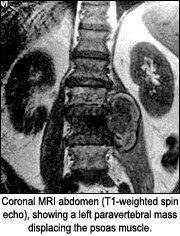
Most patients complain of some back or abdominal pain, but pain may be completely absent.2 There are reported cases in the literature of chronic aortic rupture masquerading as a psoas abscess, renal colic, obstructive jaundice due to compression of the common bile duct, and as a groin hernia.3 The reason for these pain patterns is due to the pressure from the formation of a hematoma, which often presses against the psoas muscle, and the fibers of the femoral nerve that pass around the psoas muscle.
References
Jones CS, Reilly MK, Dalsing MC, et al. Chronic contained rupture of abdominal aneurysms. Arch Surg 1986;121:542-6.
Larsson EM, Heiling M, Holtas S. Aortic pathology revealed by MRI in patients with clinical suspicion of spinal disease. Neuroradiology 1993;35:499-502.
Rosenthal D, Clark MD, Stanton PE, et al. Chronic contained rupture of abdominal aortic aneurysm. Is it real? J Cardiovasc Surg 1986;27:723-4.
The proposed merger of the National Board of Chiropractic Examiners and Federation of Chiropractic Licensing Boards was approved by NBCE delegates and FCLB members at their respective annual meetings, held jointly in Atlanta, Ga., this year. Per the new bylaws, the new entity takes the NBCE name, with FCLB continuing as a department within NBCE. The federation will continue to enjoy Board of Directors representation on what will be a single, expanded board.
Before introducing subscapularis syndrome as an upper extremity analog, it is essential to revisit piriformis syndrome as a well-established example of myogenic pseudo-radiculopathy. Piriformis syndrome has long served as a clinical exception to disc-centric models of lower extremity pain and provides an important framework for understanding how deep muscular dysfunction can mimic radiculopathy in the absence of nerve root compression.
Pain has become the dominant language of musculoskeletal healthcare. Numeric pain-rating scales and symptom reports are routinely used as primary indicators of clinical success. But while pain reduction is meaningful, it is an incomplete and often misleading representation of recovery. This has real consequences for patient adherence, long-term outcomes, and how conservative care is perceived within the broader healthcare system.