As chiropractors, we often evaluate patients with a scoliosis. It is very important to document the method used to evaluate the patient's curvature. For comparison purposes, one should also state which method of mensuration was utilized and which levels were used for reference points. There are two common methods for evaluating curvatures in the thoracic spine:
The Ferguson's method referenced in Ferguson: Roentgen Diagnosis of Extremities and Spine 1949, which describes the following technique:
Define the margin of the apical vertebrae of the curvature as well as the vertebra which defines the ends of the curve at the upper and lowermost margins of the curve.
Place central points in each of these three vertebrae and connect them by lines forming an angle. This angle is called the angle of the curve, that is, the divergence from 180 degrees.
Make sure you state in your report the end vertebra and the apical vertebra, in order to re-evaluate any further change in the curve.
The second manner of measuring a curve is the Cobb's method referenced in Cobb: American Academy of Orthopedic Surgery 1948. It is still the preferred method, and is performed by:
Defining the end vertebra of a curvature and placing a horizontal line on the uppermost margin of the upper vertebra and the lower end-plate of the lower vertebra.
Extending these lines and drawing perpendicular lines to the end-plates. The angle formed by these perpendiculars is the angle of the scoliosis.
Again, one should always document which method and which reference points were used to allow accurate re-evaluation of the curve years later.
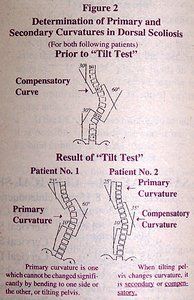
Regarding a scoliosis, there is often an associated compensatory curve in the lumbar spine, which is secondary to a primary curve in the thoracic spine. To determine which is the primary and which is the secondary curve, a tilt test can be performed. When a patient laterally flexes, the primary curve usually will not change significantly; the secondary curve will change with lateral flexion.
Primary curvature is one which cannot be changed significantly by bending to one side or the other, or tilting pelvis.
When tilting pelvis changes curvature, it is secondary or compensatory.
Once the primary curve has been determined, treatment should be directed at resolving or correcting this curve, as the secondary curve will improve once the primary curve has diminished.
The proposed merger of the National Board of Chiropractic Examiners and Federation of Chiropractic Licensing Boards was approved by NBCE delegates and FCLB members at their respective annual meetings, held jointly in Atlanta, Ga., this year. Per the new bylaws, the new entity takes the NBCE name, with FCLB continuing as a department within NBCE. The federation will continue to enjoy Board of Directors representation on what will be a single, expanded board.
Before introducing subscapularis syndrome as an upper extremity analog, it is essential to revisit piriformis syndrome as a well-established example of myogenic pseudo-radiculopathy. Piriformis syndrome has long served as a clinical exception to disc-centric models of lower extremity pain and provides an important framework for understanding how deep muscular dysfunction can mimic radiculopathy in the absence of nerve root compression.
Pain has become the dominant language of musculoskeletal healthcare. Numeric pain-rating scales and symptom reports are routinely used as primary indicators of clinical success. But while pain reduction is meaningful, it is an incomplete and often misleading representation of recovery. This has real consequences for patient adherence, long-term outcomes, and how conservative care is perceived within the broader healthcare system.