Accessory ossicles in the foot are abundant, making it difficult to assess whether or not there is a fracture.
os talotibiale
os supratalare
an avulsion, not an accessory bone
os supranaviculare
os infranaviculare
os intercuneiforme
os cuneometatarsale II dorsale (also os cuneometatarsale dorsale fibulare)
os intermetatarsale
os unci? Coalescing with the fourth metatarsal bone?
accessory skeletal element distal to the cuboid (wandering os unci?)
secondary cuboid (cuboides secundarium)
calcaneus secundarius
os tibiale externum
trigonum
os accessorium supracalcaneum
posterior calcaneal spur, not an accessory bone
os subcalcis
inferior calcaneal spur, not an assessory bone
bursitis, not an accessory bone
peroneal bone (os peroneum)
os vesalianum
Most of the time a simple evaluation of the opposite foot will allow one to differentiate most fractures from an accessory ossicle.
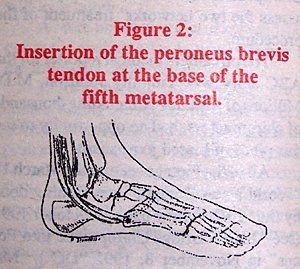
One of the most commonly missed fractures that can be mistaken as an accessory ossicle is an avulsion fracture at the base of the fifth metatarsal. Avulsion of the styloid process of the fifth metatarsal are caused by an inversion injury to the ankle, stressing the peroneus brevis tendon which causes an avulsion at the insertion of this tendon.
Usually the patient will describe a history of stepping off a curb or falling down the stairs. Clinically, this fracture initially appears to be an injury to the ankle, due to the marked swelling which occurs over the lateral aspect of the ankle. If only ankle films are taken, this fracture will be missed.
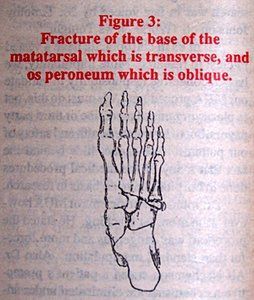
This fracture can also be confused with the os peroneum. Radiographically these two entities can be differentiated by the direction of the fracture line. The fracture line is usually oriented transversely in relationship to the base of the matatarsal. In contrast, when an os peroneum is present, the line of separation is usually obliquely longitudinal in relationship to the base of the metatarsal.
If the fracture is non-displaced, a compression bandage can be used along with restricting weight-bearing until the edema has resolved. If the fracture is displaced, the ankle and foot should be immobilized in the neutral position. Referral to an orthopedist or podiatrist would be recommended for proper management unless the chiropractor is proficient in casting techniques and fracture management. Ice and pulsed ultrasound also can be very helpful in reducing the edema. It should be noted that if the fracture remains open after nine months and is still symptomatic, surgical intervention may be necessary.
Deborah Pate, D.C., DACBR San Diego, California
Editor's Note:
Dr. Pate's book, Case Studies in Chiropractic Radiology is now available through MPI's Preferred Reading and Viewing list. Please see pages xx, Part #T123 for further information on how to order your copy.
While cervical disc pathology can unquestionably produce radiculopathy, many patients presenting with arm pain, paresthesia or perceived weakness do not exhibit the clinical behavior of true nerve-root compromise. In these cases, failure to differentiate the primary pain generator may lead to unnecessary spinal injections, nerve ablation procedures or surgical consultation despite limited likelihood of benefit.
The New Jersey Board of Chiropractic Examiners has made a precedential decision, concurring with the Association of New Jersey Chiropractors' (ANJC) position paper on chiropractic X-ray guidelines. In plain terms, the board ruled, consistent with the ANJC position, that insurance companies cannot use medical X-ray rules or recommendations, like those written by the American College of Radiology (ACR), to decide whether a chiropractor's X-ray was necessary.
For decades, chiropractors have been told the answer to more professional referrals is simple: educate medical doctors about chiropractic. There is some truth in that advice; but it is also incomplete. The modern challenge is not simply getting another healthcare professional to know that chiropractors exist. It is becoming the kind of clinician (and building the kind of professional relationship) that makes collaboration easy and sustainable.