George E. Hariman was born on the Isle of Mitylene in Greece on 23 January 1893 (Rehm, 1980, p. 290). At the age of 16, he arrived in Chicago. He began night school classes in English and enrolled at the National School of Chiropractic (NSC). He was very much impressed with his experience at the Cook County (Illinois) Hospital (Gibbons, 1983). John Howard,DC, founder and first president of the NSC, was still in the saddle when Hariman graduated in 1914, but the young chiropractor was undoubtedly also influenced by William Schulze,MD,DC (Keating & Rehm, 1995 a&b), then an instructor at the NSC and later its second president (1919-1936). Hariman established his first practice in Chicago (1914-1919), but subsequently took over a small chiropractic hospital in River Park, North Dakota for a brief period.
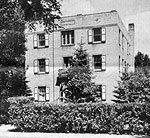
The Hariman Sanatorium, founded by George Hariman,DC, circa 1950.
Dr. Hariman returned to private (out-patient) practice in 1924, when he established a clinic in Grand Forks, North Dakota. In 1927, he commenced construction of the Hariman Sanatorium in Grand Forks, a four-story structure that was opened to the public in 1928, despite strenuous opposition from the local medical community (Gibbons, 1983). He was most proud that his facility "built, planned and operated by ourselves was the first chiropractic hospital to be specifically built for its purpose in our nation - a hospital of 25 beds" (Hariman, 1970, p. 32).
In addition to manipulative treatments, the institution also provided physiological therapeutics, including "short and ultra-shortwave diathermy; deep therapy; sinusoidal and galvanic currents; ultraviolet ray and colonic irrigation for thorough cleansing" (from a pamphlet of the Hariman Sanatorium). Lab analyses and round-the-clock nursing care were also provided, and the hospital reputedly expanded to 60 beds (Gibbons, 1983). It proudly advertised:
The progress of the Hariman Sanatorium through more than a quarter century is because of the hundreds who have received benefit from services rendered. Many cases came only 'as a last trial' after repeated efforts, failures, and discouraging verdicts. "Heart disease, liver and gall bladder disorders, ulcers of the stomach, fallen bowels, chronic indigestion, constipation, rheumatism, neuritis, neuralgia, sinus trouble, hemorrhoids, tonsils, paralysis, high blood pressure, asthma, pleurisy, bronchitis, flu, eczema, ulcers of the eye, running ears, and other diseases have been successfully treated here...
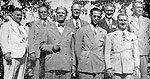
Board members and officers of the NCA gathered at Port Perry Ontario in 1946 to dedicate the memorial to DD Palmer. (From left): Drs. Frank Logic; F. Lorne Wheaton; John Nugent; Loren Rogers; Floyd Cregger; Gordon Goodfellow; George Hariman; and Emmett Murphy
Hariman's efforts on behalf of chiropractic hospitals and sanitaria continued throughout his career, and he always believed in the importance of hospital training for chiropractors. He was a founding member in 1934 (Gibbons, 1983) and officer of the National Chiropractic Association's (NCA's) Council on Hospitals and Sanitaria, and was responsible for passage of the first state law to regulate chiropractic in-patient facilities in 1947 (Hariman, 1970, p. 33-4).
By this time, Dr. Hariman was already accomplished in legislative and professional affairs. He is credited with preparing North Dakota's chiropractic act of 1933, which authorized the use of physiotherapeutics by chiropractors. By this time he was also serving as editor of the Bulletin of the North Dakota Chiropractic Association, a post he held for 46 years (Rehm, 1980, p. 290). He also served several terms as president of his state society, and was a member of the North Dakota Board of Chiropractic Examiners for five years. Dr. Hariman was a leader in several defeats of basic science legislation in North Dakota, but was also an activist in the NCA's campaign to raise educational standards throughout the profession. The minutes for the NCA Council on Education's meeting in Atlantic City during 4-8 July 1955, reflect his commitment to the NCA's crusade:
Dr. George Hariman, president of the North Dakota Board, maintained that the two year pre-professional college requirement had served to eliminate not only the poorer students, but would also help to eliminate the poorer schools." (Minutes, 1955)
Indeed, it was in the arena of national professional activities that this forever optimistic Greek-American made some of his most important contributions. Dr. Hariman was first elected state delegate for North Dakota to the NCA's House of Delegates in the early 1930s, and contributed repeatedly to the NCA's journal (see Table 1). In 1943, he succeeded to the seat previously held by C.O. Watkins,DC, on the NCA's Board of Directors, and was elected chairman of the board for 1946-47. Dr. Hariman continued on the NCA's executive board through 1951, but along the way he picked up a variety of additional responsibilities. He enthusiastically promoted the formation of a student loan fund by the NCA leadership. On 26 July 1944, Hariman was one of the co-incorporators (see Table 2 on page 36) and served on the first board of trustees of the Chiropractic Research Foundation (CRF), forerunner of today's Foundation for Chiropractic Education and Research (FCER). Two years later, as a member of NCA's Board of Directors, he was also a co-founder and officer of the National Chiropractic Insurance Company (NCIC), predecessor of today's NCMIC.
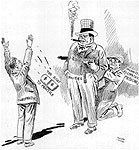
Chiropractors' view of basic science legislation, as depicted in the NCA's Chiropractic Journal in 1936.
Table 1: Several papers authored by George Hariman,DC.
Our state experiment proved to be a chiropractic achievement! The Chiropractic Journal (NCA) 1934 (May);3(5):5.
Hospitalization - a searching analysis of our present needs. (An address given at National Convention). The Chiropractic Journal (NCA) 1935 (Jan);4(1):7-8,42.
Hospitalization - a chiropractic need! The Chiropractic Journal (NCA) 1935 (June);4(6):12. The good will court. The Chiropractic Journal (NCA) 1937 (Jan);6(1):52-3.
North Dakota wins again. The Chiropractic Journal (NCA) 1937 (Nov); 6(11):54-5.
Hospitalization is the fifth industry of the modern world. The Chiropractic Journal (NCA) 1938 (June); 7(6):9-10.
Chiropractic statutes - a general revision is now indicated. The Chiropractic Journal (NCA) 1938 (July); 7(7):9.
Your cooperation is requested! The Chiropractic Journal (NCA) 1939 (May);8(5):49.
Basic science acts: are they a professional benefit or bugaboo? The Chiropractic Journal (NCA) 1940 (Apr); 9(4):10.
Basic science subjects must be included in regular curriculum. The Chiropractic Journal (NCA) 1940 (June);9(6):19.
Chiropractic enters a new era. National Chiropractic Journal 1945 (Apr);15(4):32,48.
Hospital legislation. National Chiropractic Journal 1945 (Aug);15(8):23, 46.
Chiropractic hospitals and sanitaria. National Chiropractic Journal 1945 (Oct);15(10):21.
Requirements for chiropractic hospitals approved for intern training. Webster City IA: National Chiropractic Association, revised July 29, 1950.
The price of liberty - eternal vigilance. Journal of the National Chiropractic Association 1951 (Nov); 21(11):26.
Chiropractic hospitals should command the support of the entire profession. Journal of the National Chiropractic Association 1952 (Feb); 22(2):9,60,62,64.
Chiropractic hospitals as research centers make an important contribution. Journal of the National Chiropractic Association 1952 (May);22(5):123,70.
Medical vs. chiropractic centers. ICA International Review of Chiropractic 1952 (Nov); 7(5): 9-10.
Management of multiple sclerosis cases in chiropractic hospitals. Journal of the National Chiropractic Association 1957 (Feb);27(2):13-4.
We must provide chiropractic hospitals for internships of graduates. Journal of the National Chiropractic Association 1957 (Apr);27(4):19-20.
A hospital development program is mandatory for professional advancement. Journal of the National Chiropractic Association 1957 (June); 27(6):15-6,65-6.
Guidance in the establishment of chiropractic hospitals. Journal of the National Chiropractic Association 1957 (Sept);27(9):21,72-3.
An analysis of chiropractic hospital operational costs. Journal of the National Chiropractic Association 1957 (Dec);27(12):19-20.
The need for chiropractic hospitals becomes increasingly important to our profession. ACA Journal of Chiropractic 1964 (Sept);1(9):32.
The educational clinics. CA Journal of Chiropractic 1966 (Feb);3(2):27.
Table 2: Founders of the Chiropractic Research Foundation (today's FCER) in 1944 (Schierholz, 1986).
Sylva Ashworth,DC (Nebraska)
Lillard Marshall,DC (Kentucky)
Gordon Goodfellow,DC,ND (California)
Harry McIlroy,DC (Indiana)
George Hariman, DC (North Dakota)
Cecil Strait,DC (Georgia)
Frank Logic,DC (Michigan)
F. Lorne Wheaton,DC (Connecticut)
The chartered purposes of the research agency included:
To receive gifts for the use and benefit of chiropractic education, research, sanitarium, hospitals, and to administer said gifts according to its discretion, except as to gifts subject to a condition of the donor, which gifts are to be administered according to said conditions.
To promote the science of chiropractic, particularly in the research of all the scientific aspects of chiropractic.
To promote adequate facilities and equipment for the full and complete education of students in chiropractic colleges.
To promote chiropractic sanitariums, hospitals and clinics.
To gather and disseminate reliable information concerning the science of chiropractic, and to generally promote the science of chiropractic (Schierholz, 1986, p. 4)."
The NCIC's charter specifically mandated that policyholders waive "all claims for dividends" (Articles, 1946), and although not specifically stated in the mutual insurer's articles of incorporation, the intention of this legal stipulation was to allow the company's surplus funds to be directed to philanthropy, especially upgrades in NCA-accredited chiropractic college facilities and faculties. Hariman's affection for his alma mater and his close personal relationships with many of the presidents of chiropractic schools are attested to in surviving correspondence (e.g., Hariman, 1952; Janse, 1959; Logan, 1952) and his later writings (Hariman, 1970). In his dual capacities as a member of the governing boards of the malpractice insurer and the research organization, Hariman was in a position to tap into funds (NCIC) and redirect them to worthy projects through the NCA's philanthropic arm (CRF). This is a part of the behind-the-scenes story of chiropractic educational improvements that has yet to be told in detail.
George Hariman continued his contributions to the profession he loved well into his senior years. He operated his hospital with the assistance of his wife and his son, Donald Hariman, DC, and continued to serve in-patients and outpatients throughout his lifetime (the institution closed during the summer of 1981). In the late 1960s, he turned his concern for the profession's future toward an understanding of the past: preparation of a brief history of chiropractic education in North America. Self-published during a critical period (the final push in the early 1970s for federally recognized accreditation; Keating et al., 1998), A History of the Evolution of Chiropractic Education (Hariman, 1970) was the most thorough treatise on the topic up to that time. Hariman, the self-taught scholar, drew upon many sources within the profession (he specifically named George Haynes,DC,MS, Dave Palmer,DC, Thure Peterson,DC, and Clarence Weiant,DC,PhD), as well as his own five decades as a chiropractor, to trace the paths the training enterprise had taken. It is not known to this writer how widely Hariman's booklet was distributed. Despite its brevity (44 pages), no chiropractic historian can ignore this work.
In his final years, his profession bestowed a variety of honors upon this pioneer, including: fellowship in the International College of Chiropractors; a meritorious service citation from the American Chiropractic Association (ACA) in 1968; lifetime membership in the ACA in 1970; and honors from the North Dakota Chiropractic Association and the National College of Chiropractic. Appropriately recognized in his lifetime, Hariman's legacy has largely been ignored since his passing on 13 September 1977 in Grand Forks. Surely, the contributions of this accomplished profession-builder, warrant further investigation.
References
Aesculapian (college yearbook). Glendale: Los Angeles College of Chiropractic, 1950.
Articles of incorporation (National Chiropractic Insurance Company) approved by Chas. R. Fischer, Commissioner of Insurance for the Insurance Department of Iowa; filed in Hamilton County, Iowa on January 4, 1946 at 10:30 AM for a recording fee of $1.10 (NCMIC Archives).
Gibbons RW. Chiropractors as interns, residents and staff: the hospital experience, 1910-1960. Chiropractic History 1983;3:50-7.
Hariman G. Letter to Vinton F. Logan, DC, April 25, 1952 (Cleveland papers, Cleveland Chiropractic College of Kansas City).
Hariman GE. A History of the Evolution of Chiropractic Education. Grand Forks, ND: the author, 1970.
Janse Letter to George E. Hariman, 17 July 1959 (Janse papers, National College of Chiropractic, Library Special Collections).
Keating JC, Callender AK, Cleveland CS. A History of Chiropractic Education in North America: Report to the Council on Chiropractic Education. Davenport, IA: Association for the History of Chiropractic, 1998.
Keating JC, Rehm WS. William C. Schulze, MD, DC (1870-1936): from mail-order mechano-therapists to scholarship and professionalism among drugless physicians, part I. Chiropractic Journal of Australia 1995a (Sept);25(3):82-92.
Keating JC, Rehm WS. William C. Schulze, MD, DC (1870-1936): from mail-order mechano-therapists to scholarship and professionalism among drugless physicians, part II. Chiropractic Journal of Australia 1995b (Dec);25(4):122-8.
Logan, Vinton F. Letter to Carl S. Cleveland Jr., 10 May 1952 (Cleveland papers, Cleveland Chiropractic College of Kansas City).
Minutes of the annual meeting of the National Council on Education of the National Chiropractic Association, Hotel Claridge, Atlantic City, 4-8 July 1955 (Appendix B in: Keating JC, Callender AK, Cleveland CS. A History of Chiropractic Education in North America: Report to the Council on Chiropractic Education. Davenport IA: Association for the History of Chiropractic, 1998).
Rehm WS. Who was who in chiropractic: a necrology. In: Dzaman F et al. (eds.) Who's Who in Chiropractic, international. Second edition. Littleton CO: Who's Who in Chiropractic International Publishing Co., 1980.
Schierholz AM. The Foundation for Chiropractic Education and Research: A History. Arlington VA: The Foundation, January 1986 (unpublished).
Author's note: The AHC's 2001 Conference on Chiropractic History will be held at Palmer College of Chiropractic West in San Jose, California, March 30-April 1. Details about the conference can be obtained from the AHC's executive director, or by checking the AHC website at [url=http://www.chirohistory.com]http://www.chirohistory.com[/url].
While cervical disc pathology can unquestionably produce radiculopathy, many patients presenting with arm pain, paresthesia or perceived weakness do not exhibit the clinical behavior of true nerve-root compromise. In these cases, failure to differentiate the primary pain generator may lead to unnecessary spinal injections, nerve ablation procedures or surgical consultation despite limited likelihood of benefit.
The New Jersey Board of Chiropractic Examiners has made a precedential decision, concurring with the Association of New Jersey Chiropractors' (ANJC) position paper on chiropractic X-ray guidelines. In plain terms, the board ruled, consistent with the ANJC position, that insurance companies cannot use medical X-ray rules or recommendations, like those written by the American College of Radiology (ACR), to decide whether a chiropractor's X-ray was necessary.
For decades, chiropractors have been told the answer to more professional referrals is simple: educate medical doctors about chiropractic. There is some truth in that advice; but it is also incomplete. The modern challenge is not simply getting another healthcare professional to know that chiropractors exist. It is becoming the kind of clinician (and building the kind of professional relationship) that makes collaboration easy and sustainable.