The Chirons: Images from World War II and Afterward - Part II
Joseph Keating Jr., PhD
Editor's note: Part I of the aticle appeared in the September 18 issue of Dynamic Chiropractic
The birth of the Dominion Council of Canadian Chiropractors (today's Canadian Chiropractic Association) was prompted in part by chiropractors' desire for commissioned officer status in the Canadian military services. The Council's efforts to attain status with the military were not successful, as reported by 1926 Palmer graduate Joshua N. Haldeman, D.C. in the March 1943 issue of the National Chiropractic Journal:
CANADIAN ARMY SAYS NO CHIROS
Canadian army authorities are not sympathetic towards the granting of Chiropractic attention to the armed services, according to Dr. J.N. Haldeman, Regina, who returned recently from Ottawa, where he had attended the first annual meeting of the Dominion Council of Canadian Chiropractors.
A delegation headed by Dr. Walter Sturdy, Vancouver, conferred with Hon. J.L. Ralston, minister of national defense, and Brigadier Meakins, assistant director general of medical services. Following the interview, Dr. Haldeman said Dr. Sturdy and his delegation reported that "chiropractors could not hope to be better than orderlies" under the military medical organization.
Hardly Recognized
Brig. Meakins told the delegation, Dr. Haldeman said, that in the South African war, even dentists were hardly recognized, but that in the last war they made a large contribution, which was followed by the formation of a dental corps in this war.
The idea was conveyed that in the next war chiropractors may have a separate classification," Dr. Haldeman said in his report on the interview with the brigadier and Col. Ralston.
Dr. Haldeman said the chiropractors were despondent because this feeling on the part of military authorities would not allow them to enter the army in the post to which they were best suited. Instead, they had to enlist as combatants. This was particularly disappointing, the chiropractors stated, because the Dominion is short 300 doctors.
In Russia, it was pointed out, chiropractors and medical doctors are placed on a par. (News, 1943)
(Another news story of the WWII era)
"Greater Love Hath No Man"
A Courageous Chiron in the Armed Forces Sets an Excellent Example for Chiropractors on the Home Front.
Love of the chiro-practic profession, and the desire to spread its benefits to all mankind, is everywhere. From somewhere on a might ocean, aboard one of Uncle Sam's aircraft carriers, comes proof of this statement.
Chas. C. Lemly, D.C., secretary-treasurer of the Chiropractic Research Foundation, Inc., is in receipt of a stirring letter, and a Founder's pledge of $1,000.00 from K.H. Evert, Chief Pharmacist's Mate, U.S.N.
Chiron Evert is a graduate of Lincoln College and had 4,309 hours credit. He is a D.C., M.C., and Ph.C. For over 30 months he has been doing physiotherapy work in the Navy as well as having taught the subject to Navy groups. His pledge of $1,000.00 to the Chiropractic Research Foundation, Inc., will be paid on a monthly basis through an allotment to the Foundation.
He suggests, and urges, every chiron (chiron is the designation for chiropractors in the Armed Forces who are members of the American Society of Military Chiropractors) who can possibly do so to make a pledge and pay it through an allotment. He believes this to be the best and surest way of paying his pledge, which, he says: "I consider an obligation, my obligation to a fine profession; the one I intend to follow through life."
Dr. Evert is a strong believer in higher educational qualifications for the practice of chiropractic. He believes the success of the Foundation is a safeguard for the chiropractors' future.
Upon his discharge from the Navy he intends to take a refresher course and settle down to practice in his home town of Allentown, Pa. He already holds licenses in North and South Carolina and Texas... (Greater, 1945).
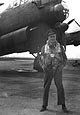
Seen here standing in front of his Lancaster bomber in England during World War II, Lt. Herbert J. Vear of the Royal Canadian Air Force, future member of the first class at Canadian Memorial Chiropractic College and future president of the Western States Chiropractic College, served as a navigator in missions over Germany.
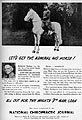
Government advertisement for war bonds appeared in the June 1945 issue of the National Chiropractic Journal
At war's end, official chiropractic's efforts turned to securing training benefits for veterans interested in studying chiropractic, and in securing reimbursement for chiropractic services to veterans. As had been the case following World War I (Keating, 1994; Keating et al., 1998), "chiroschools" surged in enrollments when they were approved for G.I. benefits. Various student bodies organized chapters of the American Legion and the Veterans of Foreign Wars. The first class at the Canadian Memorial Chiropractic College, which commenced its coursework on 18 September 1945, was mostly comprised of World War II veterans. It was a "no-nonsense" group that took its studies very seriously (Keating, 1997; Vear & Keating, 1999).
National Chiropractic Journal 1947 (May); 17(5): 37; journal caption reads: "Commander Frank O. Logic being greeted by R.M. Newitt, President at A.S.M.C. meeting at Canadian Memorial College in Toronto on March 8-9. Others are George G. Reynolds, Sgt. at Arms, Dr. A.E. Homewood, Hon. Pres., and Howard L. Gauthier, Historian." A. Earl Homewood, D.C., N.D. of Toronto is center; Frank O. Logic, D.C. of Iron Mountain, Michigan is far right. Homewood, who served in the North Atlantic with the Royal Canadian Navy during World War II, joined the faculty of the Canadian Memorial Chiropractic College (CMCC) in 1945, and later served as CMCC president and dean.
Returning chiropractor-veterans were welcome back to the National Chiropractic Association at war's end in this 1946 cartoon from the National Chiropratic Journal.
References
Cleveland, Carl S., Sr. Letter to T.F. Ratledge, D.C., 12 October 1942 (Ratledge papers, Cleveland Chiropractic College of Kansas City)
Evert, Kenneth H. Plans, policies and organization of American Society of Military Chiropractors. National Chiropractic Journal 1947 (Mar); 17(3): 15-7
Greater love hath no man. National Chiropractic Journal 1945 (Apr); 15(4): 33
Keating JC. The influence of World War I upon the chiropractic profession. Journal of Chiropractic Humanities 1994; 4: 36-55
Keating JC. 1997 Lee-Homewood Heritage Award: Herbert J. Vear, D.C., chiropractic scholar. Chiropractic History 1997 (June); 17(1): 9-13
Keating JC, Callender AK, Cleveland CS. A history of chiropractic education in North America: report to the Council on Chiropractic Education. Davenport IA: Association for the History of Chiropractic, 1998
News flashes: Canada. National Chiropractic Journal 1943 (Mar); 12(3): 26-7
Ratledge TF. Letter to Carl S. Cleveland, Sr., D.C., 16 February 1943 (Ratledge papers, Cleveland Chiropractic College of Kansas City)
Rogers, Loran M. Editorial. National Chiropractic Journal 1945b (Sept); 15(9): 6
Rogers, Loran M. On the fighting front. National Chiropractic Journal 1945a (Apr); 15(4): 30-1
Stearns, Cliff. It's time to open chiropractic treatment to veterans and Medicare recipients. Journal of the American Chiropractic Association 2000 (July); 37(7): 50-1
Vear HJ, Keating JC. Donald Campbell Sutherland, D.C., LL.D., F.I.C.C., chiropractic statesman and diplomat. Journal of the Canadian Chiropractic Association 1999 (Sept); 43(3): 183-8
If your interest in chirohistory has been stimulated, then consider joining the Association for the History of Chiropractic (AHC). Founded at Spears Hospital in Denver in 1980, the AHC is a non-profit, membership organization whose goal is the discovery, dissemination and preservation of the saga of chiropractic. The AHC held its first annual Conference on Chiropractic History at the Smithsonian Institute in Washington, D.C. in 1980, and has held similar conferences each years since at various chiropractic colleges. The AHC's 2001 Conference on Chiropractic History will be held at Palmer College of Chiropractic West in San Jose, California during March 30-April 1. Details about the upcoming conference can be obtained by the AHC's executive director, or by checking the AHC website at http://www.chirohistory.org.
The AHC publishes a scholarly journal, Chiropractic History, in which chiropractors and interested observers contribute their expertise to telling and interpreting the rich lore of the profession. The journal, which is indexed in the National Library of Medicine's Histline, is published twice per year. Chiropractic History is distributed to all members of the AHC as a membership benefit. Membership in the AHC can be obtained by sending your name, address and check for $50 ($20/year for students) to the AHC's executive director:
Alana Callender, M.S., Executive Director Association for the History of Chiropractic 1000 Brady Street, Davenport IA 52803 USA
If you'd like to encourage historical scholarship and preservation within the chiropractic profession, then consider making a donation, large or small, to the historical fund of the National Institute of Chiropractic Research (NICR). The NICR is a non-profit organization committed to conducting and supporting various types of research; in most cases, contributions are tax-deductible. The NICR historical fund supports the work of chiropractic historians and of centers for the preservation of historical documents. Preparation of this paper was supported by the NICR. Please make your check payable to: Historical Fund National Institute of Chiropractic Research P.O. Box 80317, Phoenix AZ 85060-0317 USA
The proposed merger of the National Board of Chiropractic Examiners and Federation of Chiropractic Licensing Boards was approved by NBCE delegates and FCLB members at their respective annual meetings, held jointly in Atlanta, Ga., this year. Per the new bylaws, the new entity takes the NBCE name, with FCLB continuing as a department within NBCE. The federation will continue to enjoy Board of Directors representation on what will be a single, expanded board.
Before introducing subscapularis syndrome as an upper extremity analog, it is essential to revisit piriformis syndrome as a well-established example of myogenic pseudo-radiculopathy. Piriformis syndrome has long served as a clinical exception to disc-centric models of lower extremity pain and provides an important framework for understanding how deep muscular dysfunction can mimic radiculopathy in the absence of nerve root compression.
Pain has become the dominant language of musculoskeletal healthcare. Numeric pain-rating scales and symptom reports are routinely used as primary indicators of clinical success. But while pain reduction is meaningful, it is an incomplete and often misleading representation of recovery. This has real consequences for patient adherence, long-term outcomes, and how conservative care is perceived within the broader healthcare system.