It was Virchow in 1852 who first described muscular rheumatism.1 In 1904, Gowers2 described fibrositis as an underlying pathology for a number of musculoskeletal disorders. Since that time, physicians and researchers have come up with a number of terms to describe a category of inflammatory muscular disorders and conditions which are common and which have been extremely difficult to categorize, due in large part to the general lack of objective clinical data and to the ambiguity of the terminology.
For example, Kellgren3 described some of his findings (of referred pain) in ways which suggest he was describing myofascitis. This has been the interpretation of other authors,4,5 although I disagree. Nevertheless, much confusion exists even today, particularly with regard to the distinction between myofascitis and fibromyalgia.
Fibromyalgia Syndrome (FS)
Fibromyalgia syndrome (FS) is a chronic disorder involving the entire body: above and below the waist, and on both sides. It is much more prevalent in females. It has been associated with more than 46 different infections, metabolic, neurologic and neoplastic diseases.6 In these cases it is referred to as secondary fibromyalgia syndrome. When it is free standing it is referred to as primary fibromyalgia syndrome (PFS). For our purposes, I will use the terms FS and PFS synonymously.
Making the Diagnosis
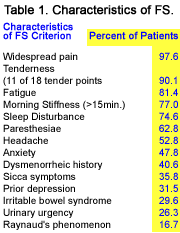
Patients with FS have a number of complaints in common; these are listed in Table 1, which is from Wolfe7 and is compiled from the American College of Rheumatology (ACR) 1990 criteria study.8 The ACR also established 18 tender points that were commonly found in these patients. The anatomic descriptions of these points are listed in Table 2 (see page 29). One might be temped to argue that these descriptions are somewhat ambiguous.
However, even more nebulous is the prescribed method of determining that which is tender and that which is not. For example, the spot is to be rolled under the fingertips while exerting about 4 kg downward pressure. The patient is asked whether the point is tender or painful. Only the painful response is considered positive, even though the examiner must not attempt to qualify the answer.7 (Perhaps they should have called them painful points.) One critic of FS has commented that "the concept of FS is valid only in the sense that it includes all possibilities."9 Certainly, using the criteria given, one can make a diagnosis of FS quite often.
To qualify as having FS, a patient must have the following:
widespread pain (above and below the waist and on both sides of the body) for at least three months duration;
axial spine pain (cervical, chest, thoracic or lumbar);
at least 11 of 18 tender points;
at least three of the following:
fatigue;
sleep disturbance;
anxiety;
irritable bowel syndrome;
headache;
paresthesiae.
Table 2. American College of Rheumatology 1990 Criteria for the Classification of FS
History of widespread pain
Pain on both sides of body.
Pain above and below the waist.
Axial skeletal pain (cervical, or anterior chest, or thoracic, or lumbar spine).
Pain in 11 of 18 tender points
Occiput-bilateral, at the suboccipital muscle insertions.
Low cervical-bilateral, at the anterior aspects of the intertransverse spaces at C5-C7.
Trapezius-bilateral, at the midpoint of the upper border.
Supraspinatus-bilateral, at origins, above the scapular spine, near the medical border.
2nd rib-bilateral, at the second costochondral junctions, just lateral to the junctions on upper surfaces.
Lateral epicondyle-bilateral, 2 cm distal to the epicondyles.
Gluteal-bilateral, in upper outer quadrants of buttocks in anterior fold of muscle.
Greater trochanter-bilateral, posterior to the trochanteric prominence.
Knees-bilateral, at the medial fat pad proximal to the joint line.
Adapted from reference 265.
Comorbid Disorders
It is difficult sometimes to decide just what it is that constitutes fatigue, and what level of anxiety is clinically important. Similarly, how often should headaches occur before we consider them relevant in this context? Does one per week qualify? On the other hand, there is a strong association between poor sleep and increased symptom expression. Romano10 has correlated irritable bowel syndrome with FS.
Based on a survey of 554 patients with FS, additional comorbid conditions have been reported as follows: mitral valve prolapse, bursitis, constipation, diarrhea, TM joint dysfunction, vertigo, sinus, and thyroid problems.11 FS patients also display high lifetime rates of migraine, irritable bowel syndrome, chronic fatigue syndrome, major depression, and panic disorder, as well as high rates of familial mood disorder-all of which may share a common etiopathophysiology with FS.12
Can FS Be Linked To Trauma?
FS has been linked to trauma in some studies,13-16 although these are not definitive, and may be aggravated by trauma in minimally symptomatic patients, or may be precipitated in those predisposed to developing the condition. White et al.17 systematically reviewed the literature of FS to investigate the strength of the connection between trauma and the condition. Although one recent Israeli study found that adults with neck pain were at a ten-fold increased risk of developing FS within a year, the study had some methodological limitations. Other studies provide the basis of a hypothetical construct for an association between trauma and FS based on 1) postinjury sleep abnormalities; 2) local injury sites as a source of distant regional pain; and 3) the concept of neuroplasticity. There are, however, the authors point out, several competing arguments against a causal connection, including the notion that FS may not be a distinct clinical entity. The psychological state may be most influential on the development of FS. Their conclusion was that the definitive answer remains elusive.
In another interesting study,18 these authors surveyed 287 Canadian GPs, 160 orthopedists, 160 physiatrists, 160 and rheumatologists on the diagnosis of FS in a theoretical case. The case involved a 45-year-old female injured in a motor vehicle crash in which she sustained a whiplash injury. Subsequently she developed chronic widespread pain, fatigue, sleep difficulties, and diffuse muscle tenderness. The orthopedists were least likely to agree with the diagnosis of FS (28.8%), while rheumatologists were most likely to agree (83.0%). Factors found to predict agreement (on the basis of multivariate analysis) included 1) the number of FS cases diagnosed by the respondent per week; 2) the patient's gender; 3) the force of impact; 4) the patient's pre-crash psychiatric history; and 5) the severity of the initial injuries.
It is my opinion that some patients are predisposed to develop FS or already have a minor, but tolerable, case of FS. These cases are then precipitated or aggravated by certain forms of trauma resulting in long-term discomfort. Ultimately, however, we must wait for more definitive studies before we can trust in more than our personal opinions as to the cause-and-effect relationships between trauma and FS.
Multiple Sclerosis
There have been reports describing a connection between multiple sclerosis and mild traumatic brain injuries (MTBI),19 although the epidemiological link appears weak.20 Nevertheless, in 1996 a former policeman in England was awarded $820,000 after developing multiple sclerosis following a CAD injury sustained in the line of duty.21 Unfortunatly for the policeman, the award was turned around on appeal two years later.22 At this writing, the link between whiplash and MS remains unproven and poorly supported by the existing literature.
Gowers WR: Lumbago: its lesions and analogues. Br Med J 117-121, 1904.
Kellgren JH: On distribution of pain arising from deep somatic structures with charts of segmental pain areas. Clin Sci 4:35-46, 1939.
Jinkins JR, Whittemore AR, Bradley WG: The anatomic basis of vertebrogenic pain and the autonomic syndrome associated with lumbar disk extrusion. AJNR 10:219-231, 1989.
Goldman LB, Rosenberg NL: Myofascial pain syndrome and fibromyalgia. Sem Neurol 11(3):274-280, 1991.
Diagnostic and Statistical Manual of Mental Disorders, third edition (DSM-III). American Psychiatric Association, Washington, DC, 1980.
Wolfe F: Diagnosis of fibromyalgia. J Muscoloskel Med 53-69, 1990.
Wolfe F, Smythe HA, Yannus MB, et al.: The American College of Rheumatology 1990 criteria for the classification of fibromyalgia: report of the multicenter committee. Arthritis Rheum 33:160-172, 1990.
Cohen ML, Quintner JL: Fibromyalgia syndrome, a problem of tautology. Lancet 342(8876):906-909, 1993.
Romano TJ: Concurrent fibromyalgia and irritable bowel syndrome. Pain Pract 3(1):4-7, 1991.
Waylonis GW, Heck W: Fibromyalgia syndrome-new associations. Am J Phys Med Rehab 71(6):343-348, 1992.
Hudson JI, Goldenberg DL, Pope HG, et al.: Comorbidity with medical and psychiatric disorders. Am J Med 92(4):363-367, 1992.
Magn£sson T: Extracervical symptoms after whiplash trauma. Cephalalgia 14(3):223-227, 1994.
Waylonis GW, Perkins RH: Post-traumatic fibromyalgia: a long-term follow-up. Am J Phys Med Rehab 73(6):403-412, 1994.
Borenstein D: Prevalence and treatment outcome of primary and secondary fibromyalgia in patients with spinal pain. Spine 20(7):796-800, 1995.
White KP, Carette S, Harth M, Teasell RW: Trauma and fibromyalgia: is there an association and what does it mean? Seminars in Arthritis & Rheumatism 29(4):200-216, 2000.
White KP, Ostbyte T, Harth M, Nielson W, Speechley H, Teasell R, Bourne R: Perspectives on posttraumatic fibromyalgia: a random survey of Canadian general practitioners, orthopedists, physiatrists, and rheumatologists. J Rheumatol 27(3):790-796, 18. 2000.
Poser CM: The role of trauma in the pathogenesis of multiple sclerosis: a review. Clin Neurol Neurosurg 96:103-110, 1994.
Kurland LT: Trauma and multiple sclerosis. Ann Neurol 36:S33-S37, 1994.
Christie B: Multiple sclerosis linked with trauma in court case. BMJ 313:1228, 1996.
Christie B: Appeal overturns link between multiple sclerosis and whiplash. British Med J 316:799, 1998.
Arthur Croft,DC,MS,FACO,FACFE Director, Spine Research Institute of San Diego San Diego, California drcroft@san.rr.com
The proposed merger of the National Board of Chiropractic Examiners and Federation of Chiropractic Licensing Boards was approved by NBCE delegates and FCLB members at their respective annual meetings, held jointly in Atlanta, Ga., this year. Per the new bylaws, the new entity takes the NBCE name, with FCLB continuing as a department within NBCE. The federation will continue to enjoy Board of Directors representation on what will be a single, expanded board.
Before introducing subscapularis syndrome as an upper extremity analog, it is essential to revisit piriformis syndrome as a well-established example of myogenic pseudo-radiculopathy. Piriformis syndrome has long served as a clinical exception to disc-centric models of lower extremity pain and provides an important framework for understanding how deep muscular dysfunction can mimic radiculopathy in the absence of nerve root compression.
Pain has become the dominant language of musculoskeletal healthcare. Numeric pain-rating scales and symptom reports are routinely used as primary indicators of clinical success. But while pain reduction is meaningful, it is an incomplete and often misleading representation of recovery. This has real consequences for patient adherence, long-term outcomes, and how conservative care is perceived within the broader healthcare system.