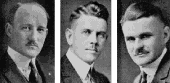
The National School of Chiropractic, renamed the National College of Chiropractic (NCC) circa 1919, was another source of irritation to B.J. Palmer. John Howard, the Palmer graduate who founded the school in Davenport in 1906, had departed the Chicago institution by 1919. B.J. met Howard's successor, William C. Schulze, in 1916 (Fountain, 1916), and apparently found him to his liking, despite Schulze's advocacy of various broad-scope methods of practice. The two took turns in appearing at one another's homecoming programs (Fountain, 1917). B.J. described his first address to the National's annual convocation:
...came an invitation to address the National School of CHIROPRACTIC, from the President, Dr. Schultze.[sic] It was accepted with the greatest of pleasure. At 9 a.m. Saturday, April 27th, we were met by Dr. Schultze at the Hotel LaSalle and taken to the school. Here, at 11 a.m. we met the classes in assembly. We were given carte blanche to say what we pleased in any way we wanted as long as our wind lasted. I got started discussing general conditions and how the war was affecting schools, including the CHIROPRACTIC ones (for, wasn't this on my mind most?) and talked for just one long hour. I brot to this student body the request for closer co-operation between their school and themselves; themselves and their school; a little higher appreciation of their Faculty and its each member, etc., etc.
After this was over, Mabel was called upon for a "few words" (Dr. Schultze ought to know women better) and she's invited the gang down to the lectures for the morrow. We were escorted thru and shown all over the National School, as it was our first time to ever visit and talk to this institution. Altho Dr. Schultze has been here frequently, before our student body, this was our first before him...
In the evening we gave AFTER TOMORROW - WHAT? at the Auditorium of THE Y.M.C.A. The introduction was formally made by Dr. Cochrane in introducing Dr. Schultze as Dean of The National School of CHIROPRACTIC who, in turn, very candidly and frankly chose his words in introducing the speaker of the evening. I appreciated this courtesy upon Dr. Schultze's part very much. It but again proves the big heartedness and broad-mindedness of the man... (Palmer, 1918).
But if Schulze's politeness endeared him to the Developer, his partner at the NCC, Arthur L. Forster, produced a different reaction. Forster had grown disgusted with the public feud between Palmer and Carver; in a sarcastic editorial in the National Journal of Chiropractic he suggested that:
The two Chiefs stand high in the profession at least insofar as their leadership of their respective tribes is concerned...The "thots" of the Chief must be the thoughts of the tribe and when any member of the tribe shows an inclination to say or do anything contrary to the teachings of the Chief, he is shot with word bullets. Chief Bee Jay uses mostly "Guts" bullets and Chief Carve Her employs most large caliber word shells...
The continuous warfare between these rival Chiefs has undoubtedly worked much harm in the profession at large. One of the most pernicious effects has been the bad opinion which many people have formed of the profession as a whole on account of the constant fighting between the two Chiefs...
The principal trouble with the Chiefs is that they are extremists...Chief Bee Jay says that all disease is caused by vertebral subluxations and nothing else; on the other hand, Chief Carve Her avers that no diseases are caused by subluxations but that the subluxations are the disease...They are only right in one thing and that is their ability to see that the other is wrong. We'll give them credit for that (Forster, 1919).
B.J. Palmer, Indian Chief
When Forster penned an article concerning chiropractic treatment for various forms of cancer of the stomach, Palmer promptly rebutted:
Any time that Dr. Forster thinks he has us stumped on CHIROPRACTIC questions, he is grandly mistaken. Answering questions, establishing facts, has been our business for years. We had hoped, yet hardly dared, to think that Dr. Forster would actually fall headlong into the trap that we made for him on this article of his, to which he refers, which was NOT Chiropractic...
"Carcinoma" is carcinoma, in one or a thousand and one. It cannot be one thing in Jack and something else in Jill...To assume that Jack has "carcinoma" and that Jill has the same thing and has some other kind of a cause is to play medicine... Specific effects, specific causes - THAT'S CHIROPRACTIC. To have one thousand kinds of "carcinomas" with one thousand kinds of "cause" with one thousand kinds of treatment ("Chiropractic treatment") is medicine. To imply that there are many "causes," NOT "universal" is to try to beg medical theories into a specific Chiropractic fact...
Dr. Forster would be an excellent Chiropractic teacher if he knew anything at all about some of the principles of Chiropractic (Palmer, 1920).
Palmer's followers seemed to agree with the Developer's differential assessment of Schulze vs. Forster; one PSC graduate indicated that:
I enjoyed some of my course at the National in Chicago. The material presented by Dr. Forster was about what one might expect from him. If he weren't an M.D. he couldn't get by with his stuff, as it is he doesn't get by with any one who knows Chiropractic at all. I had to see him deliver his art instruction, or I would never on earth have believed that any one taught students to adjust in such a manner. Sometime I will have more time and will then explain what he teaches; it is absurd beyond belief. His lectures were not Chiropractic, they were medical and electrical. When asked what was best to do in a case of Infantile Paralysis, he replied, "Use the vibrator."
I scowled and shook my head. He then said, "Oh, of course I'd adjust also." Several times I couldn't help but protest, and I was always balled out by teachers and most students. Because I had been studying at THE PSC I was heartily suspicioned. The National School is not a Chiropractic school; its methods are primarily - osteopathic, electric and medical. Students pull, stretch, concuss, massage, and adjust (sometimes a dozen vertebrae). It requires more than a quarter of an hour to give a "treatment."
I do, however, believe that the opportunity to visit hospitals and witness post mortems is of value to National students of anatomy.
I had few exceptions to take in Dr. Schulze's lectures. He teaches chiropractic. He is kindly and painstaking, and seems to be very much liked by the entire student body. I never heard him advocate the use of adjuncts. I doubt if he knows the sort of stuff that Forster advances (Norvall, 1920).
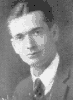
Arthur L. Forster,MD,DC, circa 1919
The especially sore points between Palmer and Forster involved the latter's call for diagnostic training for chiropractors and higher educational standards (Forster, 1923). B.J. maintained that diagnosis was irrelevant for chiropractors and that the curriculum should be limited to 18 months of training. The pair traded opinions and insults until the mid-1920s, when Forster left the NCC.
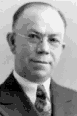
W.A. Budden,DC,ND
However, the spitting match between the Fountain Head and the NCC continued under the National College's new dean and the Journal's new editor (1926-1929), W.A. Budden, DC, ND (Keating & Rehm, 1995). Budden also battled with B.J. for decades (1929-1954) as president of the Western States College, School of Chiropractic & School of Naturopathy in Portland, Oregon.
Though the relationship between the NCC's and the PSC's respective presidents remained generally cordial, Rehm, 1995). Budden also battled with B.J. for decades (1929-1954) as president of the Western States College, School of Chiropractic & School of Naturopathy in Portland, Oregon. And though the relationship between the NCC's and the PSC's respective presidents remained generally cordial, Schulze eventually felt compelled to challenge B.J.'s insistence on the "short course" for chiropractic students. He turned the Developer's motto, "Get the BIG IDEA, and all else follows" back upon him:
W.C. Schulze,M.D.,D.C., circa 1932
...first and foremost, and to be brutally frank about it, we are, as a profession, not well enough educated. We have drilled into too large a number of our people such fallacies as "Get the idea and nothing else matters," when we are all more or less slowly admitting what we should have known all the while, namely, that a river cannot rise higher than its source. Our fellow citizens care not so much what we say or think of ourselves, but rather do they compare us, as individuals making up a profession, with other individuals making up another profession, such as the medical, for instance. And isn't the comparison justified? Regardless of what we practice, should we not first of all, in our general intelligence, compare favorably with our competitors, the medical men? If we admit this we can overcome our defects to a large extent. We turn from "loud speakers" into students. We then cultivate the scientific instinct. We leave this idea in the minds of our fellow citizens: "Well, the Doctor of Chiropractic, seems to be a very intelligent person." But first of all we must recognize, as a profession, that the thing which is holding us back or pulling us down is our own lack of education, generally speaking...
The writer, as well as anyone who has ever appeared before legislators, knows that an high school qualification seems the most obvious requirement and yet [this] has been persistently fought... (Schulze, 1932).
G. Alvin Fisk, DC, PhC, first editor of the Chirogram magazine
The opinions expressed in the NCC's house organ were increasingly endorsed by other elements of the educational community. In an editorial (Fisk, 1923) in The Chirogram, published by the Los Angeles College of Chiropractic (LACC), G.A. Fisk, D.C. seconded Forster's call for higher standards:
One of the finest articles it has been our pleasure to read for many a day was contained in the NCC Journal recently, the author Dr. A.L. Forster. The subject was the necessity of raising the standards of chiropractic education, particularly the pre-chiropractic educational requirements. Some oppose this step. We shall try to believe that their motives are sincere.
That the early pioneers in Chiropractic did not pos-sess a high-school education or its equivalent is no argument to be applied to the present situation. As Dr. Forster aptly states, in those days it was chiropractic that was subjected to a test. Because of its inherent merit, that method has won the public confidence to an extent that assures it a place in the healing art for all time. Now, however, it is not chiropractic but chiropractors who are under examination by the public.
The fact that Chiropractic has won recognition in many states of the Union, instead of assuring it a protected future, as so many seem to assume, is, in fact, the greatest menace to its perpetuation. Herein Dr. BJ Palmer concurs, for he has consistently displayed in his utterances and writings a note of doubt as to the ultimate value of legal recognition to chiropractic. However, we believe his reason for believing so is incorrect. He is against raising the pre-chiropractic educational requirements because he evidently fears it will cut down the output of chiropractors, thereby permitting the opposition to maintain an eternal numerical supremacy. We believe there are enough chiropractors in the country to safeguard the privileges so far won. A sufficient number of people are believers in chiropractic to help defend those rights.
Eventually, even those who considered themselves straight practitioners came to question the advisability of continuing with a limited course of instruction. In a commentary that mirrored the ideas held by Schulze, a field doctor decried the profession's seeming penchant for ignorance:
...To my mind, and I am sure to a great many others, there is no such thing as an absolutely "straight" and finally settled philosophy. That is to say, our philosophy is as yet so young - and is in that process of development where as yet it is not possible to judge a man entirely as to his "orthodoxy" by what we now know, except on a few points that are demonstrable facts upon which all are most certainly agreed, regardless of school training. I hold no brief for Dr. Palmer nor for any one opposed to him, and I am writing this in a strictly impartial spirit as my honest opinion with respect to a very grave matter; so grave, in fact, as to deserve more than a passing thought, or perhaps a lot of senseless, silly enthusiasm....
Dr. Palmer seems to think that no one is to blame for our present condition as he describes it but the mixer. I concede that the mixer is without doubt greatly responsible, but not entirely the cause...I do not think that the public at large is concerned in the least whether a man is straight or a mixer. If anything, and I am ashamed to acknowledge the fact, for, like Dr. Palmer, personally I have absolutely no use for the mixer, the general public, strange to say, seems to be decidedly in favor of the mixer, and considers the straight man from whatever school as more or less of a rabid fool. And I do not know but what the public, in very many ways, is right, for many so-called straight chiropractors seem to be absolutely devoid of ordinary reason and good common-sense about which they talk so much, but never practice.... I have known the heads of certain schools who actually go so far as to say that they prefer as students the blank, unlettered, unlearned and untrained minds, as they usually make the best chiropractors, knowing full well the impossibility of getting trained minds to follow their foolish philosophies. This is not fiction, but a fact. Could anything be more disgusting or preposterous! In the name of all that is good, when will we forsake such nonsense? That is what is killing us, this seeming encouragement of ignorance. The public, as it expresses itself through the magazines as it has done of late and will continue to do until we have some sort of respectable unity within our ranks, is concerned for the most part over the vain babblings of those who say that there is no need of chemistry, physics, physical diagnosis, pathology or anything of the sort; that there is no need of quarantine or health laws; that there is no need of license or regulation; that there is no need of other doctors; that there is no need of observing any kind of rule or regulation, divine or otherwise, with regard to health, so long as you take adjustments; that there is no need of having a diseased appendix operated; that it is not necessary to get plenty of good food, rest, fresh air and sunshine and the like in connection with adjustments in order to get well; that adjustments will cure everything from corns to lice; that this is no good; that that is no good, ad infinitum, ad nauseam, and then some, that makes us the laughing stock of scientific men and the public at large.
It is the taking of cases by both straights and mixers that cannot possibly be helped by adjustments, and deceiving the helpless in just such instances, that the public is becoming disgusted with and rightly. Make no mistake about it. It is foolish philosophy of some of us and our money-grabbing propensities that the public cannot and will not swallow; so that it becomes not so much a question with them of straight or mixing, but of lying chiropractors...We will never be what we ought to be until we learn to think for ourselves and not follow the ready-made opinions of others. God speed that day when the qualifications for becoming a chiropractor will be such that only those that know how to think and think right will be desired in the profession, and when there shall be an end to the idea that the most ignorant make the best chiropractors, and that only a minimum of preliminary education should be required of those who intend to study our science. Unless we go up, we must go down. A profession that thrives on ignorance cannot long survive... (McCartney, 1922).
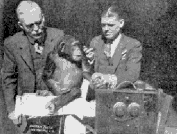
Charles H. Wood, D.C., N.D. (far right), president of the Los Angeles College of Chiropractic, demonstrates his diagnostic neurometer to friends, circa 1925
And so it went, year in and year out, each side arguing that its vision of chiropractic was superior, and the field split loosely along college lines. A new high in arrogance was reached in 1924, when Palmer introduced his two-pronged, spinal heat sensing instrument, the neurocalometer (NCM). Arguing that no one could find a subluxation as accurately or efficiently by traditional means (i.e., palpation, nerve-tracing), B.J. insisted that practice without the NCM was unethical and possibly hazardous. The Palmer School offered the instrument to the field by means of a 10-year lease at $2,200, and threatened to sue for patent-infringement anyone who made use of one of the many rival devices that sprung onto the market.
Many competing instruments were offered by chiroschools, such as the "diagnostic neurometer" of the LACC. The NCM's introduction (Keating, 1991) prompted the departure from the Palmer School of four core faculty members, who subsequently established the Lincoln Chiropractic College in Indianapolis.
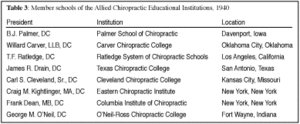
The struggles among the chiroschools reached a cross roads in 1939-40, when the National Chiropractic Association (NCA), formed in 1930 from the merger of two smaller national membership societies (Keating & Rehm, 1993), released its first standards for the accreditation of chiropractic colleges. Alarmed by the NCA's apparent desire to mandate greater than 18 months of chiropractic education, as well as instruction in subjects Palmer and allies considered "not chiropractic" (e.g., physiotherapy, improved basic science instruction), straight college leaders organized the Allied Chiropractic Educational Institutions (see Table 3) and issued an ultimatum:
The Allied Chiropractic Educational Institutions in convention assembled at Kansas City, Missouri, this the 20th day of July, A.D. 1940, present this address to the National Chiropractic Ass. and to the Chiropractic Health Bureau, and each and all allied or independent organizations professedly within the Chiropractic profession...
To the National Chiropractic Association, the Chiropractic Health Bureau, and all allied organizations purporting to be within the Chiropractic profession, the Allied Chiropractic Educational Institutions goes on record and states that unless a reorganized plan of your bodies, association, or by whatever name known, reorganize, amend and change said organizations in such way as to be in conformity with the suggestions and demands of allied educational institutions, we find it is necessary that we shall withdraw all support that has ever come from the members of this organization to your organization in every way, shape and manner, and we say to you now in all kindness and truth that unless reorganization, amendments, etc., are accomplishments by you within a reasonable time, the members of the Allied Chiropractic Educational Institutions shall feel free to organize a separate national organization that will be strictly Chiropractic in all of its departments, and will look to carrying out, all and singular, the things that have been said in this address. This matter has been fully considered and unanimously passed by this organization, which has signed the same as such and each of its members has signed in his individual capacity...
- Per TF Ratledge, D.C., Secretary, Jas. R. Drain, Acting President (Allied, 1940).
Table 3
The challenge issued by the ACEI marked a new era in the chirowars. For the next half century the chiropractic colleges, organized in several competing groups, would do battle in the courtrooms for control of the educational enterprise. In many respects, their continuing struggles mirrored the issues and strategies of the early college wars. And the feuds continue today.
Three of the co-founders in 1926 of the Lincoln Chiropractic College of Indianapolis; left to right: James Firth, DC; Harry E. Vedder, DC and Stephen J. Burich, DC
Frank Dean, MB, DC, president of the Columbia Institue of Chiropractic in New York City, and co-founder of the Allied Chiropractic Educational Insitutions
References:
Allied Chiropractic Educational Institutions. In the matter of the preservation of chiropractic. Kansas City, Missouri, July 20, 1940.
Carver caught in his own trap. Fountain Head News 1919 [A.C. 25] (Dec 13); 9(13): 1-2.
Consolidation. American Drugless Healer 1913 (Aug); 3(4): 75-6Fisk GA. Editorial. The Chirogram 1923 (June); 2(2): 2.
Forster AL. Editoral: the Chief hath spoken. National (School) Journal of Chiropractic 1919; May, pp. 7-9 (bound volume pp. 614-6).
Forster AL. Higher chiropractic standards. National (College) Journal of Chiropractic 1923 (Feb); 11(6): 10-18
Fountain Head News 1916 [Feb 19]; 5[4]: 2.
Fountain Head News 1917 [A.C. 22] (Sept 8); 6(51-52): 24.
Fountain Head News 1917 [A.C. 23] (Nov 3); 7(8): 2.
Gibbons RW. Solon Massey Langworthy: keeper of the flame during the "lost years" of chiropractic. Chiropractic History 1981;1:14-21.
Gibbons RW. Fred Collins and his New Jersey "Mecca." Chiropractic History 1989 (June); 9(1): 41.
Gibbons RW. Minnesota, 1905: who killed the first chiropractic legislation? Chiropractic History 1993 (June); 13(1): 26-32.
Gregory AA. Spinal treatment. Second Edition. Oklahoma City: Palmer _ Gregory College of Chiropractic, 1912, p. xi
Jackson RB. Willard Carver, LLB, DC, 1866-1943: doctor, lawyer, Indian chief, prisoner and more. Chiropractic History 1994 (Dec); 14(2): 12-20
Keating JC. Introducing the neurocalometer: a view from the Fountain Head. Journal of the Canadian Chiropractic Association 1991 (Sept); 35(3):165-78
Keating JC. Craig M. Kightlinger, MA, DC and the Eastern Chiropractic Institute. Journal of Chiropractic Humanities 1996; 6:26-44.
Keating JC, Rehm WS. The origins and early history of the National Chiropractic Association. Journal of the Canadian Chiropractic Association 1993 (Mar); 37(1): 27-51.
Keating JC, Rehm WS. William C. Schulze, M.D., D.C. (1870-1936): from mail-order mechano-therapists to scholarship and professionalism among drugless physicians, Part II. Chiropractic Journal of Australia 1995 (Dec); 25(4): 122-8.
Kightlinger CM. Letter to B.J. Palmer. Fountain Head News 1919 [A.C. 24] (May 3); 8(33): 14.McCartney WJ. House Cleaning from another angle. National (College) Journal of Chiropractic 1922 (Dec); 11(5): 4-7.
Norvall CL. Letter to B.J. Palmer. Fountain Head News 1920 [A.C. 26] (Nov 27); 10(11): 1-2.
Palmer BJ. Letter to W.C. Schulze, MD, DC Fountain Head News 1919b (July 26); 8(45): 8.
Palmer BJ. Fountain Head News gladly replies. Fountain Head News 1920 [A.C. 25] (July 31); 9(46): 6-8.
Palmer BJ. The Palmer School of Chiropractic has NO branch schools. Fountain Head News 1921 [A.C. 26] (Feb 19); 10(23): 16.
Schulze WC. The future of chiropractic: an inventory of our assets and liabilities. Journal of the International Chiropractic Congress 1932; 1(5): 5, 16.
The proposed merger of the National Board of Chiropractic Examiners and Federation of Chiropractic Licensing Boards was approved by NBCE delegates and FCLB members at their respective annual meetings, held jointly in Atlanta, Ga., this year. Per the new bylaws, the new entity takes the NBCE name, with FCLB continuing as a department within NBCE. The federation will continue to enjoy Board of Directors representation on what will be a single, expanded board.
Before introducing subscapularis syndrome as an upper extremity analog, it is essential to revisit piriformis syndrome as a well-established example of myogenic pseudo-radiculopathy. Piriformis syndrome has long served as a clinical exception to disc-centric models of lower extremity pain and provides an important framework for understanding how deep muscular dysfunction can mimic radiculopathy in the absence of nerve root compression.
Pain has become the dominant language of musculoskeletal healthcare. Numeric pain-rating scales and symptom reports are routinely used as primary indicators of clinical success. But while pain reduction is meaningful, it is an incomplete and often misleading representation of recovery. This has real consequences for patient adherence, long-term outcomes, and how conservative care is perceived within the broader healthcare system.