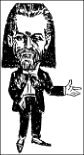
At the Los Angeles College of Chiropractic we offer a twice-yearly course in chiropractic history. The primary text for the course is Chiropractic: History & Evolution of a New Profession (St. Louis: Mosby, 1992) by Walter Wardwell,PhD. What follows is a sample from the last of three tests administered at the completion of the course. An answer key is provided at the end of the test. Good luck, and have fun!
DIRECTIONS: choose the best answer: Each correct multiple-choice answer is worth 2 points. A = 90-100; B = 80-89; C = 70-79; D = 60-69; F < 60
1. Nerve-tracing was invented by Oakley Smith,DC, as part of naprapathy, and was used by B.J. Palmer as a substitute for x-ray until the neurocalometer was introduced.
a) true b) false
2. D.D. Palmer coined the term "subluxation" and was the first person to manipulate the spine in order to relieve disease.
a) true b) false
3. This author of the Neurodynamics of the Vertebral Subluxation served briefly as president of the LACC; who was s/he?
a) Linnie Cale, b) A. Earl Homewood c) George Haynes
4. Old Dad Chiro's final theory of chiropractic rejected the idea that nerves were pinched in the intervertebral foraminae, arguing instead that subluxations altered the tension of nerves, causing them to become too tense or too slack, and thereby changing their vibrational frequency.
a) true b) false
5. Herman S. Schwartz,DC, a longtime faculty member at the Chiropractic Institute of New York, is best remembered for his work in mental health and his editing of the 1973 volume of collected papers known as Mental Health and Chiropractic.
a) true b) false
6. According to B.J. Palmer,DC,PhC, education constipates the mind.
a) true b) false
7. The Council on Chiropractic Education (CCE) is best considered:
a) a regional accrediting agency b) a regulator of state boards of chiropractic examiners c) a division of the American Chiropractic Association d) a standard-setting agency for professional education
MATCH COLUMN B TO COLUMN A (use items in Column B only once)
COLUMN A
8. ___ Western States College 9. ___ Cleveland Chiropractic College/Los Angeles 10. ___ Universal Chiropractic College
COLUMN B
a. William Alfred Budden,DC,ND b. Joy M. Loban,DC c. T.F. Ratledge,DC d. William C. Schulze,MD,DC e. Ralph J. Martin,DC,ND
11. Among the last four American states to license chiropractors (in 1974) was:
a) Oregon b) Louisiana c) Iowa
12. Which of the following sequences is correct:
a) ACA Council on Education, NCA Council on Education, CCE b) CRF, FACE, FCER c) PSC, LACC, UCC d) NCA, UCA, ACA e) LACC, College of Chiropractic Physicians & Surgeons, San Francisco College of Chiropractic
13. The attorney who represented chiropractors in the Wilk et al. case was:
a) Tom Morris b) Willard Carver c) George McAndrews d) David Chapman-Smith e) Melvin Belli
14. Although Nebraska lowered its educational requirements for the licensing of chiropractors in 1923 from 27 months to 18 months of training, no new chiropractic licenses were granted in Nebraska from 1929 to 1950, owing to the 1927 passage of basic science legislation.
a) true b) false
15. Who is W. Heath Quigley,DC,MS?
a) former director of the Clear View Sanitarium b) Mabel Palmer,DC's nephew c) President of the LACC (1976-1980) d) all of these
16. He was a student of D.D. Palmer, an inventor of adjusting instruments, and the mentor of Charles A. Cale; who was he?
a) Carl V. Schultz,MD b) Charles Wood,DC,ND c) Thomas Storey, DC
17. The founder of Basic technique was:
a) J.L. Basic,DC b) Dossa Evins,DC c) Hugh B. Logan,DC d) Ronald J. Watkins,DC
18. According to Wardwell (1992, p. 5), chiropractors' primary defense against charges of quackery was the claim that "it works."
a) true b) false
19. The early 1970s are considered a time of major change for the chiropractic profession, owing to:
a) the inclusion of chiropractic services among those reimbursed under the Medicare program b) the first accreditation of chiropractic colleges by federally recognized accrediting agencies c) the passage of licensing legislation in the last American state d) the first federally sponsored, interdisciplinary conference on spinal manipulation e) all of these
20. The largest single funder of chiropractic research was established by NCA leaders in 1944 as the Chiropractic Research Foundation, and is known today as the Foundation for Chiropractic Education & Research (FCER).
a) true b) false
21. Who was the NCA official who helped to merge several schools to form the nonprofit LACC in 1947?
a) Joseph Janse,DC,ND b) John J. Nugent,DC c) Orval Hidde,DC,JD
22. The 1975 NINCDS conference is remembered as:
a) a federally sponsored conference on quackery and health fraud b) a meeting of DCs, DOs, MDs and scientists interested in spinal manipulation c) a convention of state licensing boards for various health care disciplines d) a government-sponsored inquiry into chiropractic in New Zealand
23. B.J. Palmer,DC,PhC called him the "Anti-Christ" of chiropractic; who was he?
a) Joseph Janse,DC,ND b) John J. Nugent,DC c) Orval Hidde,DC,JD d) Morris Fishbein,MD e) Scott Haldeman,DC,PhD,MD
24. What effect did the 1968 Cohen Report have?
a) prompted AMA to form its Committee on Quackery b) delayed chiropractors' inclusion in Medicare c) federal funding for the CCE d) prevented licensure of chiropractors in New York
25.There are no controlled clinical trials in B.J. Palmer, DC's 1951 book,Chiropractic Clinical Controlled Research.
a) true b) false
26. D.D. Palmer alternately accepted and rejected any similarity between the human body and a machine.
a) true b) false
27. One of the most important developments in the training of clinician-scholars in Canada was:
a) formation of the Dominion Council of Canadian Chiropractors b) formation of the College of Chiropractic Science c) founding of the International Review of Chiropractic
28. The chiropractic profession's predominant initial reaction to the growing threat of basic science legislation during the 1920s and 1930s was:
a) to encourage study of basic science b) grass roots political action to repeal basic science laws
29. In which of the following countries is NOT found a state-funded, university-based program of chiropractic education?
a) Australia b) Canada c) Denmark d) South Africa e) United States
30. Among the three causes of subluxations proposed by D.D. Palmer was:
a) misalignment b) nerve pinching c) auto-suggestion d) tone
31. The matriarch of the Cleveland family of chiropractors was 1910 Palmer graduate:
a) Mabel Heath Palmer b) Sylva Ashworth c) Ruth Cleveland
32. The Joint Commission on Accreditation of Hospitals (JCAH) was dismissed as a co-defendant in the Wilk et al. case on the grounds that it had resisted the efforts of the AMA and co-conspirators to "contain and eliminate" the chiropractic profession through restraint of trade.
a) true b) false
33. D.D. Palmer denied that nerves are pinched in the intervertebral foraminae, and argued that when the zygapophyseal joints subluxate, the intervertebral foraminae become larger.
a) true b) false
MATCH COLUMN B TO COLUMN A (use items in Column B only once)
COLUMN A
34. ___ homeopath 35. ___ osteopathy 36. ___ heroic medicine
COLUMN B
a. Ellen G. White b. Andrew Taylor Still c. Benjamin Rush,MD d. William C. Schulze,MD,DC e. Samuel Hahnemann,MD
37. This European chiropractor was well known for research and teaching on the subject of motion palpation; who was s/he?
a) Fred W. Illi of Switzerland b) Simon Leyson of Wales c) P.L. Gaucher-Peslherbe of France d) Jennifer Bolton of England e) Henri Gillet of Belgium
38. Which chiropractic college was formed by dissident Palmer faculty soon after the introduction of the neurocalometer?
a) National b) Lincoln c) Universal d) Columbia Institute
39. Tom Morris was the attorney who won the acquittal of Shegataro Morikubo,DC in La Crosse, Wisconsin in 1907. Morris later became chief legal counsel to the Universal Chiropractors' Association and served as lieutenant governor of Wisconsin.
a) true b) false
40. The legal basis for Dr. Shegataro Morikubo's acquittal of charges of unlicensed practice of in La Crosse, Wisconsin in 1907 was:
a) chiropractic is superior to medicine b) patients do not file complaints against chiropractors c) chiropractic has a "philosophy and practice" which is "separate and distinct" from osteopathy d) malpractice insurance was not equally available to chiropractors as it was to medical physicians e) the state has no right to restrict the practice of the healing arts to one branch of (generic) medicine
41. He had been a student of D.D. Palmer, but later discovered the "ligatite" and founded the profession of naprapathy; who was he?
a) Willard Carver,LLB,DC b) Oakley Smith,DC c) Solon Massey Langworthy,DC
Shegataro Morikubo,DC
42. He served as president of a chiropractic college from 1945 through 1982, and was responsible for the establishment of the Journal of Manipulative and Physiological Therapeutics; who was he?
a) George Haynes b) Joseph Janse c) Tom Morris d) Roy W. Hildebrandt e) C.O. Watkins
43. According to George McAndrews, what "ethical" prohibition did the AMA place upon its members in order to "contain and eliminate" the chiropractic profession?
a) the "VAP" rule b) prevented MDs from studying at chiropractic colleges c) required all AMA members to contribute to a fund to contain and eliminate chiropractic d) mandated that AMA-approved medical schools reject student applications from chiropractors
44. What was the compendium of research papers compiled by the faculty of the Canadian Memorial Chiropractic College in preparation for the 1975 NINCDS Conference?
a) CLIBCON Index b) MANTIS c) CRAC d) Grateful Thrust e) Index Medicus
45. The Universal Chiropractors' Association (UCA) was organized in 1906 by the same Palmer faculty dissidents who had founded the Universal Chiropractic College (UCC).
a) true b) false
46. D.D. Palmer's use of the word "tone" is nearly synonymous with which term?
a) homeostasis b) subluxation c) audition d) spizzerinctum e) nerve interference
47. The purpose of the B.J. Palmer Clinic in Davenport was to conduct research that would prove B.J. Palmer's theories of upper cervical subluxation (HIO).
a) true b) false
48. The Journal of Manipulative and Physiological Therapeutics has the distinction of being:
a) the first science journal published by the American Chiropractic Association b) the first science journal published by the International Chiropractors' Association c) the first chiropractic journal indexed by the National Library of Medicine d) trash published by dirty, stinking mixers who ain't got no philosophy and couldn't get sick people well if they tried
49. Membership in the Association for the History of Chiropractic (AHC) costs $20/yr for students and includes a subscription to the AHC's journal, Chiropractic History.
a) true b) false
Ernest G. Napolitano, DC, c1959, future president of New York Chiropractic College
50. Which of the following schools is the immediate predecessor of today's New York Chiropractic College?
a) Atlantic States Chiropractic Institute b) Chiropractic Institute of New York c) Empire State Chiropractic College d) Columbia Institute of Chiropractic e) Carver Chiropractic Institute
Answer Key:
B
B
B
A
A
A
D
A
C
B
B
B
C
A
D
C
C
A
E
A
B
B
B
B
A
A
B
B
E
C
B
B
A
E
B
C
E
B
A
C
B
B
A
C
B
A
A
C
A
D
If your interest in chirohistory has been stimulated, then consider joining the Association for the History of Chiropractic (AHC). Founded at Spears Hospital in Denver in 1980, the AHC is a nonprofit, membership organization whose goal is the discovery, dissemination and preservation of the saga of chiropractic. The AHC held its first annual Conference on Chiropractic History at the Smithsonian Institute in Washington, D.C. in 1980, and has held similar conferences each year since at various chiropractic colleges. The AHC's 2000 Conference on Chiropractic History will be held in San Antonio, Texas in conjunction with the annual meeting of the Association of Chiropractic Colleges, during March, 2000. Details about the upcoming conference can be obtained by contacting any CCE-accredited college.
The AHC publishes a scholarly journal, Chiropractic History, in which chiropractors and interested observers contribute their expertise to telling and interpreting the rich lore of the profession. The journal, which is indexed in the National Library of Medicine's Histline, is published twice per year. Chiropractic History is distributed to all members of the AHC as a membership benefit. Membership in the AHC can be obtained by sending your name, address and check for $50 ($20/year for students) to the AHC's executive director:
Glenda Wiese, M.A., Executive Director Association for the History of Chiropractic 1000 Brady Street Davenport IA 52803 USA
If you'd like to encourage historical scholarship and preservation within the chiropractic profession, then consider making a donation, large or small, to the historical fund of the National Institute of Chiropractic Research (NICR). The NICR is a nonprofit organization committed to conducting and supporting various types of research; in most cases, contributions are tax-deductible. The NICR historical fund supports the work of chiropractic historians and of centers for the preservation of historical documents. Preparation of this paper was supported by the NICR. Please make your check payable to:
Historical Fund National Institute of Chiropractic Research P.O. Box 80317 Phoenix AZ 85060-0317
For chiropractors practicing today, Dr. Warren Hammer’s legacy is particularly visible in several areas that have become familiar components of modern musculoskeletal care: his early work with the Graston Technique and instrument-assisted soft-tissue mobilization; his extensive writing and teaching on functional soft-tissue examination and treatment; his role in bringing fascial manipulation to U.S. clinicians; and his decades spent educating chiropractors and other health professionals.
Financial pressure, enrollment declines and institutional challenges are emerging at several U.S. chiropractic colleges. Life Chiropractic College West's and Life University's struggles may be the most talked about but appear to be part of a larger story. And with recent USDE requirements threatening to hamstring federal student financing for DC degree programs, chiropractic education is facing questions for which it has no immediate answers.
More than 100 doctors of chiropractic participated in relief efforts following the Sept. 11, 2001 terrorist attacks that left 2,753 dead and far more than the New York City skyline forever altered. Dr. Richard Gorgo Jr. was one of those DCs who selflessly donated his time, skill and compassion during that surreal, yet all-too-real moment in history. This is his remarkable story, originally published on the 10-year anniversary in 2011. Where were you when the world stopped turning? For Dr. Gorgo, the answer is Ground Zero.