In my July 30, 2001 article (http://www.chiroweb.com/archives/19/16/20.html) I introduced you to auriculo-therapy (AT), a viable addition to your toolbox of therapeutic modalities for the management of pain and various other afflictions. That article featured a protocol for tension headaches. In this article, I would like to introduce you to some of the musculoskeletal points located on the ear. However, I believe it is necessary to preface this with some auricular anatomy.
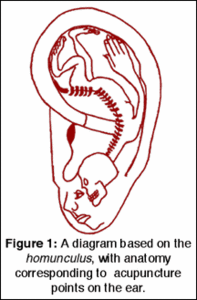
To begin with, most of us are familiar with the homunculus (diminutive man). He is the figure of a man proportioned according to the amount of brain dedicated to that anatomical part. Well, there is also one on the ear. He is oriented upside down on the ear (see Figure 1). The skull is represented on the lobe and the feet are at the top of the ear in the triangular fossa. The knees and hips are located in or around the triangular fossa and the spine is situated along the antihelix, the "y-shaped" ridge one sees in the center of the ear. Figure 2 lists and identifies the various parts of the ear.
An anatomical ear point (i.e., one named after an anatomical part) may change positions on the ear as the severity or chronicity of the condition changes. Better put, there are different phases for the anatomical points. Those corresponding with acute conditions will be found in the phase one position. That same point will be found in a different place on the ear as the condition progresses to a chronic condition (phase two) and then to a degenerative condition (phase three). It is possible to be treat a point and find that the patient is not responding as anticipated. When this occurs, changing to a different phase for the same point will very often bring the desired results. Figure 1 shows the homunculus in a phase one position.
Instead of relating to a more serious condition, phase four pertains to musculoskeletal conditions, and is found on the back of the ear. The anatomical points are found directly opposite the phase one points. Phase four points are used for musculoskeletal problems such as muscle spasms or weakness, and tendon or joint problems such as tendonitis, arthritis or bursitis, to name a few. Cervicogenic headaches that don't respond as expected to phase one point stimulation may very well respond to phase four stimulation instead. Phase four points are also indicated in conditions such as carpal tunnel, tennis elbow and rotator cuff tears.
Current research has shown that the brain, when stimulated using auriculo-therapy, releases the body's natural painkillers, endorphins and enkephalins, and the pain relief obtained has been credited to this phenomenon. However, there is more to it than just brain chemicals. This is most appreciably apparent when stimulating one ear for a bilateral suboccipital headache and the patient reports that only the side being stimulated has begun to ease. If it were only chemicals in the blood stream doing the job, the relief would be bilateral. This phenomenon points to the probability that there is a direct neurological connection between the auricle, the brain and the targeted body part. The auricle functions as not only a monitor, allowing one to diagnose a problem (search), but a keyboard, allowing us to treat the problem (stimulate/sedate).
The last thing to discuss is the order in which the points are treated. Primary points are treated before secondary; and secondary are only included if the number of points treated remains less than 12-15. Most protocols (sets of points) include master points (shen men, point zero, thalamus, etc.) and functional points (allergy, muscle spasm, antihistamine, skin conditions, etc.). One should save these points for last, as stimulation of them may cause the anatomical points to become less active and therefore not discernable when sought. Therefore, search and treat the electrically active anatomical points first, then the functional points, and the master points last, so as to tie it all together. The only exception to this would be if a master or functional point were a primary point and some of the secondary points were anatomical. In that case, treat the primary points first, as recommended above, then apply the same rules to the secondary points.
In the following protocol (see Figure 3), one should treat the anatomical points on the ear corresponding with the affected side first. Next, treat the functional points and the master points last. Keep in mind that primary points are always treated before secondary points. If an anatomical point is secondary, it would follow a master point that is primary. (See my article of July 30, 2001 for further help on the order of points).
The reference to "corresponding body points" in Figure 3 means to sedate the points on the ear that correspond with the part of the body having the muscle spasms. The approximate location can be taken from Figure 3. Remember, 10 seconds for master points or functional points (capitalized) except for shen men (20 seconds). Anatomical points should be treated until no further response is noted.
I received some inquiries in response to my last article about the number of times to treat a condition and how often. The rule of thumb is to treat a condition once a day, but you can treat acute conditions more often than that if necessary. Don't make a habit of it, though, as you may desensitize a patient to the treatment for a time. Different conditions will require different lengths of treatment. I generally begin at 2-3 times per week and monitor the patient's response. If the patient responds well, you can cut back the frequency. Continue treating and reducing the frequency until the patient is asymptomatic for 1-2 weeks.
The proposed merger of the National Board of Chiropractic Examiners and Federation of Chiropractic Licensing Boards was approved by NBCE delegates and FCLB members at their respective annual meetings, held jointly in Atlanta, Ga., this year. Per the new bylaws, the new entity takes the NBCE name, with FCLB continuing as a department within NBCE. The federation will continue to enjoy Board of Directors representation on what will be a single, expanded board.
Before introducing subscapularis syndrome as an upper extremity analog, it is essential to revisit piriformis syndrome as a well-established example of myogenic pseudo-radiculopathy. Piriformis syndrome has long served as a clinical exception to disc-centric models of lower extremity pain and provides an important framework for understanding how deep muscular dysfunction can mimic radiculopathy in the absence of nerve root compression.
Pain has become the dominant language of musculoskeletal healthcare. Numeric pain-rating scales and symptom reports are routinely used as primary indicators of clinical success. But while pain reduction is meaningful, it is an incomplete and often misleading representation of recovery. This has real consequences for patient adherence, long-term outcomes, and how conservative care is perceived within the broader healthcare system.