John Amaro, LAc, DC, Dipl. Ac.(NCCAOM), Dipl.Med.Ac.(IAMA)
It's no secret: The number-one condition that plagues mankind is low back pain. The chiropractic profession has been presented the dubious honor of being back doctors, as our avenue of approach in treating all conditions is through the spine. As more people have lumbar pain than all other conditions combined, I guess that is not such a bad thing. However, what DCs can do for somatovisceral conditions is legendary, and also the topic of a future article.
In the meantime, DCs will be challenged on a daily basis to help with uncontrollable pain of the lumbar spine due to a variety of reasons: the so-called "pinched" nerve as a result of subluxation, the more severe spinal stenosis, and the common muscle spasm. There are a variety of reasons why patients experience low back pain.
As a general rule, doctors of chiropractic achieve outstanding clinical response to lumbalgia. On occasion, despite our best efforts, we may find that a condition does not resolve, or is extremely slow in responding. Having practiced the fine art of acupuncture for so many years, I have been called on in countless occasions by my colleagues to assist in an unresolved case of low back pain.
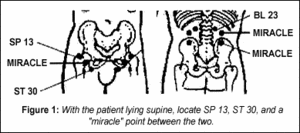
Realizing that the DC who has referred the case to me has already exhausted all of the clinical tricks of the trade, I generally approach the condition with a different mentality. The number-one thing I do in unresolved low back cases is to simply have the patient lie supine and locate three extremely tender points in the crease of the groin. These three points relate to what is known as ST 30, SP 13 and a "miracle point" between the two. This alone is magic.
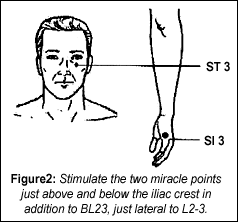
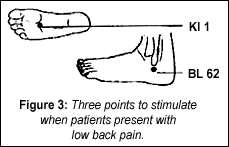
Following this, place the patient prone and stimulate two miracle points, just about and below the iliac crest, in addition to BL 23, just lateral to L2-3. The real "kicker" is to stimulate SI 3 and BL 62, followed by KI 1, and perhaps one of the most overlooked points in acupuncture for low back pain: ST 3 (on the face just below the pupil). Do all points bilaterally. In the case of SI 3 and BL 62, use the right hand and left foot, and vice-versa.
Perhaps one of the most important aspects of this treatment approach is the three points in the inguinal crease. Try this on your next unresolved case of low back pain. You'll be amazed. Remember, stimulation can be achieved after invasive (needle) or noninvasive procedures such as laser, electronic, pressure, etc. Acupuncture is a principle, not a technique. Let me know of your success.
John Amaro DC, FIAMA, Dipl.Ac (IAMA), Dipl.Ac. (NCCAOM) Carefree, Arizona
The proposed merger of the National Board of Chiropractic Examiners and Federation of Chiropractic Licensing Boards was approved by NBCE delegates and FCLB members at their respective annual meetings, held jointly in Atlanta, Ga., this year. Per the new bylaws, the new entity takes the NBCE name, with FCLB continuing as a department within NBCE. The federation will continue to enjoy Board of Directors representation on what will be a single, expanded board.
Before introducing subscapularis syndrome as an upper extremity analog, it is essential to revisit piriformis syndrome as a well-established example of myogenic pseudo-radiculopathy. Piriformis syndrome has long served as a clinical exception to disc-centric models of lower extremity pain and provides an important framework for understanding how deep muscular dysfunction can mimic radiculopathy in the absence of nerve root compression.
Pain has become the dominant language of musculoskeletal healthcare. Numeric pain-rating scales and symptom reports are routinely used as primary indicators of clinical success. But while pain reduction is meaningful, it is an incomplete and often misleading representation of recovery. This has real consequences for patient adherence, long-term outcomes, and how conservative care is perceived within the broader healthcare system.