The Columbia Schools and the Mysterious Dr. Dean, Part I
Joseph Keating Jr., PhD
He founded and presided for nearly four decades (1919-1958) over several schools, one of which would become New York Chiropractic College (NYCC). Yet very little of his life is known today. Who was the enigmatic Dr. Frank Dean?
What little is known (to this writer) comes from fragmentary sources: here an advertisement for the Columbia Institute of Chiropractic (CIC; NYCC's predecessor), a published paper there, a few recollections from those surviving DCs who studied under this mystery man in the 1940s and 1950s (e.g., Cooper, 2002; Kimmel, 1995a, b; Moross, 2002a, b; Rehm, 2000). The late historian William S. Rehm,DC, recalled of his former mentor:
"Frank Dean was and remains an enigma. I visited NYCC some years ago hoping to find in the archives anything about Dean, particularly his earlier years. It was then that Ernie {Napolitano} said two things that I found hard to believe: He (Ernie) did not personally know Dean, and that Dean had burned his personal files shortly before his death..." (Rehm, 2000).
According to Rehm (1980, p. 298), Frank Dean was born in Easton, Pennsylvania on October 13, 1891. Here the mystery begins, for little is known of his childhood or early education. Rehm tells us that Dean became a globetrotter, and earned a "bachelor of medicine" degree from the University of Warsaw prior to World War I. He apparently never listed his MB, but medical doctors were often members of his faculty. On the other hand, Columbia graduate and former faculty member Michael Moross,MS,DC, recalls that Dean's "disdain for the medical profession was ever present" (Moross, 2002a).
Rehm also indicated that Dean earned his chiropractic doctorate in 1917 from the Standard School of Chiropractic in New York City (Rehm, 1980, p. 298). However, Goldschmidt (1995b) indicated that the Standard School was not founded until 1919, the same year that Dean reportedly established the Columbia Institute of Chiropractic (Columbia, 1969; Official, 1993; Rehm, 1980, p. 298). Beideman (1995, p. 269) similarly suggests that the Standard Institute was not established until circa 1920, and The Recoil for April 1921, a newsletter published by the Standard School, indicated that the college was "organized in September, 1919" (Standard's, 1921). So just where and when did Frank Dean earn his DC? And, may we assume that the Standard School was synonymous with the Standard Institute of Chiropractic, one of several forerunners of the Chiropractic Institute of New York (Keating, 1996)?
Name of Institution
Officer(s)
Address
Advanced School of Chiropractic
Frank E. Dean, D.C., Ph.C., Registrar
234 West 75th Street
American School of Chiropractic
Benedict Lust, M.D., D.O, D.C., President, Anton Deininger, D.C., Dean
119 West 74th Street
Carver Chiropractic Institute
Willard Carver, LL.B., D.C., President & Dean
16 West 74th Street
Columbia Institute of Chiropractic
Frank E. Dean, D.C., Ph.C., President
261-263 West 71st Street
Cosmopolitan School of Chiropractic
J.E. Otto, Dean
?
International School of Chiropractic
?
155 West 73rd Street
Metropolitan Institute of Chiropractic
Louis S. Siegfried, D.C., President, Sinai Gershanek, D.C., Dean
17 Astor Place
New York College of Chiropractic*
Dr. M. Carnot, President, Charles E.C. Oswald, A.B., D.C., Dean
245 West 72nd Street; 360 West 125th Street**
National Eclectic Institute
?
1947 Broadway
Standard School of Chiropractic
W.T. Truitt, D.C., Ph.C., President, B.H. Williams, D.C., Ph.C., Dean
157 West 72nd Street
*also known as the New York School of Chiropractic
Table 1: Schools of chiropractic, their officers and locations in New York City, 1920-1923.
**School relocated in 1923
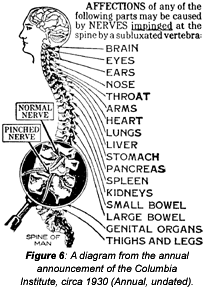
Dr. Moross, who taught anatomy, inorganic chemistry and psychology at the Columbia Institute of Chiropractic (CIC) in the 1940s, recalls his mentor as "erratic... unpredictable... disorganized"; he described Dean as 60-62 inches in height and "powerfully built" (Moross, 2002c). Dean chartered the CIC as a nonprofit corporation in Delaware, perhaps in 1920 (Annual, undated). The first campus of the new school was located at 72nd Street in New York City, but relocated to 261 W. 71st Street in November 1921, and added a second, adjacent, four-story structure in April 1923. Commencing in 1920, he concurrently operated the Advanced School of Chiropractic (Rehm, 1980, p. 298). Little more is known of this institution, but Rehm indicated that:
...Frank E. Dean was founder & president of the Advanced School of Chiropractic. The school continued in operation for a time even after the Columbia Institute was established. Both schools advertised simultaneously in the NYSCS journal - The Messenger. Dean was advertised as "founder and president" of Advanced, and "dean" of CIC. The two brownstone "campuses" were only a few blocks apart (Rehm, 1995).
The earliest known advertisement for the Advanced School appears in the July 1921 issue (p. 15) of The Messenger. Frank E. Dean,DC, was listed as "registrar"; the campus was located at 234 West 75th Street. Curiously, there was no concurrent ad for the CIC. The Advanced School was one of several chiropractic institutions that competed for students in New York City, most within a few blocks of one another (see Table 1).
Just across the Hudson River, in Newark, New Jersey, several additional competitors were situated, including Craig M. Kightlinger,MA ("Kight"), DC's Eastern Chiropractic College (Keating, 1996) and Frederick W. Collins,MD,DC's Mecca College of Chiropractic (Vernon, in press). The Veterans Bureau, forerunner of today's Veterans Administration, had approved a number of chiropractic schools as "vocational training" for veterans; one imagines that the competition for students was fierce. Former CIC student Edwin H. Kimmel, DC, suggests, "Frank Dean, from Columbia was not fond of Kight. Either it was professional jealousy or Kight's original association with BJ. Maybe they were at odds because of the two schools of thought or their competition for students" (Kimmel, 1995b). B.J. Palmer,DC, noted:
"Schools, corporations, boards of directors, secretaries, etc., are born overnight in New York. They come and they go just about as fast. They seem to think that all they have to do is to build a lot of degree-papier-mâché horses overnight, hitch them to a fairy wagon and ask certain 'honorary' people to get in and take a ride. "They seem to hold the idea that if they can but create a few more or less degrees and then honor somebody at a public meeting, and thus get some display - free advertising - out of it (at the other fellow's expense), that their school is now on Easy Street and that business will flow to them. "All that goes with the glitter and glamour is what is most desired. No institution of strength or substance ever grew that way..." (Palmer, 1920)
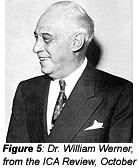
The 1920s and 1930s were also a period of intense persecution of chiropractors in New York (NY), particularly in New York City (NYC) and environs (Goldschmidt, 1995a). The allopaths of the state sought prosecution of chiropractors for practicing medicine without a license. While leaders of the New York State Chiropractic Society, such as Lyndon E. Lee,DC, and J. Lewis Fenner,DC, sought legislative relief at the state capitol in Albany from political medicine's onslaught (Goldschmidt, 1995a and b; Lee, 1923), chiropractors in NYC organized rallies and public lectures with the themes of "health freedom" and the right of citizens to the doctors of their choice (e.g., Chiro, 1927; Drugless, 1926a, b; Inquiry, 1926). Some of the largest of these, organized by William Werner,DC, and his laymen's organization, the American Bureau of Chiropractic, packed crowds of thousands into rallies at NYC's Madison Square Garden in the 1930s (Lombardo, 1990).
Dean and his Columbia Institute survived the Roaring Twenties and limped into the Great Depression of the 1930s. Rehm (1980, p. 298) noted that Dean poured revenue from his successful private practice into the CIC to keep it afloat. Although the CIC was a "straight" chiropractic school, its faculty and administration were not necessarily enamored of B.J. Palmer's theories or politics. When Major Dent Atkinson,DC, dean of CIC, agreed to make a presentation at the annual convention of the broad-scope-tolerant American Chiropractic Association in July 1929, his topic was "Cervical subluxations never produce cord pressure" (Buffalo, 1929), a direct challenge to the Davenport guru's concepts. Frank Dean was also noted among those making presentations at the ACA convention in Buffalo, N.Y. that year.
Classwork: asdjfasld;a;lska;lska;sdlfdHours Anatomy..............................................526 Neurology............................................120 Histology..............................................100 Physiology............................................175 Chemistry.............................................100 Pathology.............................................100 Chiropractic Philosophy..........................90 Chiropractic Orthopody..........................37 Symptomatology...................................173 Physical Analysis.....................................58 Gynecology.............................................58 Obstetrics................................................22 Hygiene, Sanitation and Chiropractic Pediatrics.................................................97 Dietetics...................................................22 First Aid and Toxicology...........................90 Psychology and Professional Practice........18 Embryology..............................................22 X-Ray Plate Reading.................................29 Bacteriology..............................................88 Palpation.................................................240 Adjusting Drill..........................................125 Clinical Adjusting.....................................455 Clinical Pit.................................................30 Senior Special Adjusting............................25
Total..........................2,800 Table 2:Curriculum of the CIC, circa 1930 (Annual, undated, p. 13).
The CIC offered a "standard" course involving 28 months of instruction, leading to the "DC" degree (see Table 2). A "scientific course" was also available, involving additional subjects (Annual, undated). Day and evening classes were offered, and the college advertised "bedside experience" and "dissection" (Advertisement, 1933), although the latter topic was "optional" (Advertisement, 1937). (Moross recalls that dissection was limited to bovine brains and hearts.) Dormitory space was also offered (Advertisement, 1938).
Administration & Senior Staff
Faculty (and subjects taught)
Frank E. Dean, D.C., President & Clinic Director
Major Dent Atkinson, D.C., Ph.D., LL.B., Ph.C., Symptomatology, Psychology, Philosophy
Major Dent Atkinson, D.C., Ph.D., LL.B., Ph.C., Vice President & Dean
J. Schneider, M.D., Embryology, Dietetics, Obstetrics, First Aid, Toxicology
Dr. C.J. Weaser, D.C., Ph.C., Secretary, Treasurer & Registrar
Table 3: Faculty & administration of the Columbia Institute of Chiropractic, circa 1930 (Annual, updated).
Allopathic and osteopathic physicians were eligible for advanced standing, but only for the first year of the curriculum. A "postgraduate" course, six months in duration, was also available; the CIC also granted the "PhC" degree. All undergraduate instruction was accomplished by a teaching staff of seven, including Dr. Dean (see Table 3). Tuition in the early 1930s was $20 per month.
(Part II will continue with Dr. Dean and the Columbia schools during WWII and beyond. References can be found on Part II, www.chiroweb.com/archives/20/24/07.html.)
The proposed merger of the National Board of Chiropractic Examiners and Federation of Chiropractic Licensing Boards was approved by NBCE delegates and FCLB members at their respective annual meetings, held jointly in Atlanta, Ga., this year. Per the new bylaws, the new entity takes the NBCE name, with FCLB continuing as a department within NBCE. The federation will continue to enjoy Board of Directors representation on what will be a single, expanded board.
Before introducing subscapularis syndrome as an upper extremity analog, it is essential to revisit piriformis syndrome as a well-established example of myogenic pseudo-radiculopathy. Piriformis syndrome has long served as a clinical exception to disc-centric models of lower extremity pain and provides an important framework for understanding how deep muscular dysfunction can mimic radiculopathy in the absence of nerve root compression.
Pain has become the dominant language of musculoskeletal healthcare. Numeric pain-rating scales and symptom reports are routinely used as primary indicators of clinical success. But while pain reduction is meaningful, it is an incomplete and often misleading representation of recovery. This has real consequences for patient adherence, long-term outcomes, and how conservative care is perceived within the broader healthcare system.