We were recently visited by our goddaughter's college swim team. One cannot help but notice shoulders with a group of kids who swim four to six hours a day and lift weights. Of course, they can consume a lot of calories, too. While caloric intake was interesting, the shoulder posture was even more interesting. Most of the girls had some significant forward rolling of the shoulders, even though their back muscles were well developed, and there appeared to be an imbalance between the anterior and posterior muscles of the shoulder girdle. The neck, of course, is often held slightly anterior to what we consider optimum. The reason for my concern is that shoulder problems are common in athletes and nonathletes. We call it "shoulder impingement syndrome," which we are all familiar with in our practices.
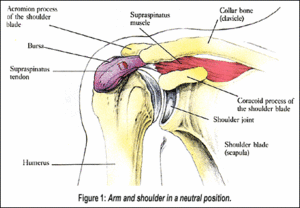
My understanding of shoulder impingement is that it is caused by the trapping of the soft tissues between the head of the humerus, and the vault formed by the acromion process of the scapula and the coracoacromial ligament. The space between the ligament and the process is small, and can be restricted further if the ligament is thickened or calcified. The anterior edge of the acromion process can become irregular with osseous spurs. The coracoacromial ligament will also show degenerative changes in the calcification, and even osseous changes, which render it inelastic. In this limited space between the acromion and the coracoacromial ligament lie the tendons of the supraspinatus, infraspinatus, teres minor and subscapularis muscles and the long tendon of the biceps, along with a bursa, which overlies the supraspinatus tendon. Looking at the anatomy (Figure 1) it seems like there is no avoiding the problem.
If one is careful not to raise the arm higher than 50 degrees, one can avoid the problem. So don't comb your hair, brush you teeth with your elbow down, and never put dishes away on any high shelves, etc. Obviously, this is not the answer. I've recently taken up yoga again. I have always been fairly flexible; but as I attempt to perform some of the positions, my rigidity, mainly in the thoracic spine, limits drastically what I can achieve. It seems that the relationship between the thoracic spine and shoulder girdle has been overlooked, at least by me. Yes, 90 percent of patients have thoracic spine problems, but I often did not relate that with the biomechanics of the shoulder.
Try doing a little test. Bring your shoulders back. What happens? The shoulders move posteriorly and superiorly, and the head and neck move forward; not a good position. First, the thoracic spine should extend slightly so the scapula can move together, then the humerus will almost automatically rotate in the glenoid because the rhomboids, which I can control, will contract.
This seems to cause the teres minor and major to fire, adducting the humerus and drawing in posterior. The upper trapezius needs to relax so the head can come posterior and the mid and lower trapezius should contract to rotate the scapula; the serratus anterior abducts the scapula and raises the ribs if the scapula stays fixed, which elevates the ribs, and, in turn, lowers the shoulders. This does not happen if the thoracic region is inflexible, preventing the costovertebral articulations from moving, which restricts the ribs from elevating. (I've lost you, I know, because I too was lost at this point, and it took me three months to find the relationship between the thoracic spine and the shoulder girdle.
Anyway, think about it when you are sitting at the computer or leaning over adjusting patients. Does your humerus rotate medially in the glenoid when in the neutral position? If it does, you are well on your way to shoulder impingement - maybe not today - but wait until you're 50 or 60 and you start looking for ways to keep adjusting patients the way you did at 30. Being a chiropractor can be tough on the shoulders!
You don't need to perform a shoulder MR on a patient with a sclerotic region on the greater tuberosity and excrescences off the AC joint. That person has some form of shoulder impingement. If you need further confirmation, just take a view of the shoulder in abduction at 80 degrees and you'll see the AC region almost touch the sclerotic region on the greater tuberosity. Take a look at the series of x-rays of a chiropractor with chronic shoulder pain (Figures 4 and 5). The patient has practiced for over 25 years.
I always wondered why there wasn't a course on how to stay healthy and practice chiropractic. Being in radiology, I've seen many a wonderful practitioner succumb to injuries caused by our profession. I would think it a privilege to be able to prevent some of the injuries we have created for ourselves. If you know of any ways to avoid injury, contact me.
Financial pressure, enrollment declines and institutional challenges are emerging at several U.S. chiropractic colleges. Life Chiropractic College West's and Life University's struggles may be the most talked about but appear to be part of a larger story. And with recent USDE requirements threatening to hamstring federal student financing for DC degree programs, chiropractic education is facing questions for which it has no immediate answers.
Musculoskeletal pain in perimenopause and menopause reflects a broader physiologic shift rather than an isolated structural problem. Declining estrogen, increased inflammation, metabolic dysfunction, and nervous system dysregulation collectively alter tissue quality, pain perception, and recovery capacity. Recognizing this interconnected model enables clinicians to move beyond symptom management and toward more effective, systems-based care that improves long-term outcomes for midlife women.
As the world remembers Dolly Parton following her death Aug. 25 at age 80, there is a little-known connection to the chiropractic profession worth revisiting: Dolly publicly acknowledged using chiropractic care and another famous entertainer even recalled meeting her at a chiropractor's office.